A model that spends more time reasoning can be useful for a difficult planning task and unnecessarily slow for extracting a date. Model selection is a product decision about acceptable quality, waiting time, and cost. The most practical system often uses different settings or models for different kinds of work.
01What extra reasoning changes
Some models expose controls over how much computation they spend working through a request. The available controls and defaults depend on the model generation and API. A setting from an older example may be ignored, deprecated, or invalid in a newer model, so check current documentation. [1]
Extra reasoning is not a guarantee of correctness. A model can deliberate over an incomplete premise or use the wrong source. Keep factual grounding and tool validation in the workflow, even when the selected model is marketed for complex reasoning.
02Think in task-specific evaluations
An evaluation needs representative tasks and a clear definition of success. A routing decision should be justified by outcomes on the work your users perform, not a broad leaderboard alone. Include easy tasks, difficult tasks, and ambiguous requests that need clarification. [2]
For an illustrative agency assistant, a fast path could classify enquiries and extract contact fields. A more deliberate path could compare conflicting technical requirements. Score both paths for correctness and useful completion, then record total processing time and model usage.
03Design a simple routing policy
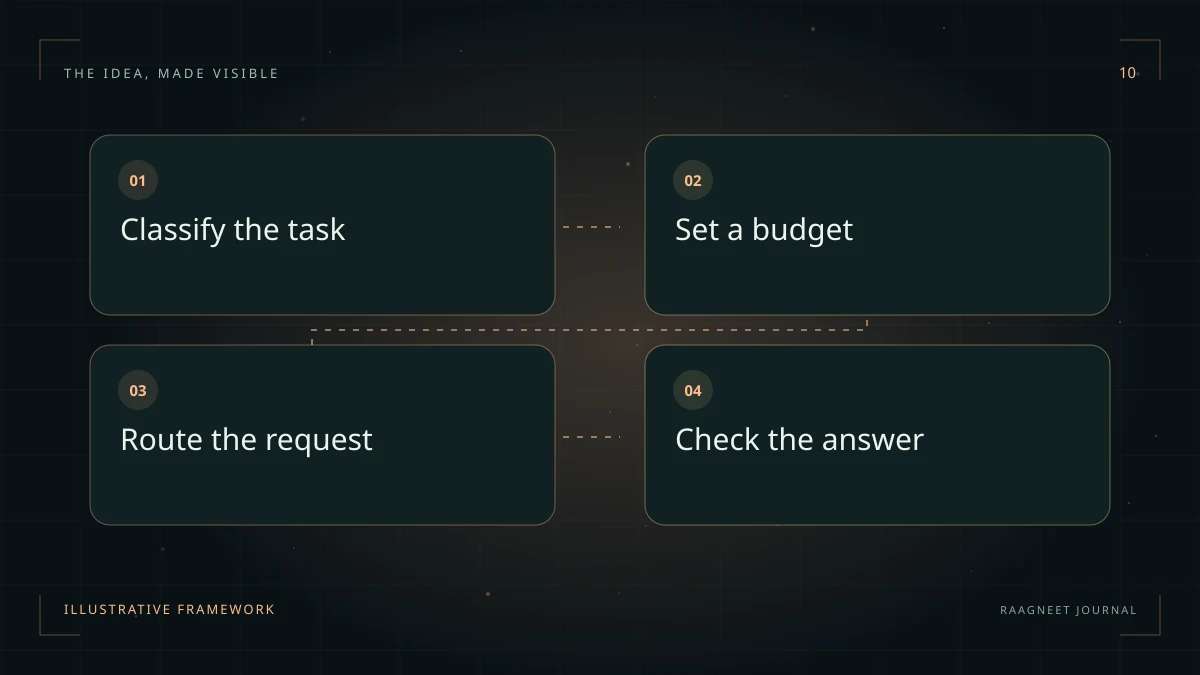
Start with explicit task categories that the application already knows. A structured extraction endpoint can use one tested configuration, while a planning endpoint uses another. This is easier to inspect than asking a second unconstrained model to decide how much effort every message deserves.
If confidence is low or validation fails, route to a stronger model or a person. Set limits on retries so an inexpensive first attempt does not trigger an unbounded chain of more expensive attempts. Preserve the original question and evidence when escalating.
04Measure the full cost of an answer
Include input tokens, generated output, any billed reasoning, tool calls, retrieval, and repeated attempts. Also consider the human effort needed to review the result. A model with a lower nominal token price can cost more per successful task if it regularly fails validation.
Use current provider pricing for a real estimate rather than a static number from an old article. Track a sample of actual request shapes, because long documents and tool transcripts may dominate costs in ways a short demonstration does not reveal.
05Make waiting feel purposeful
Show a useful progress state for longer work and let people cancel a request. Do not display a fabricated chain of thought as evidence of correctness. A short description of the current operation, such as checking the supplied requirements, is enough when it reflects a real step.
Review the routing policy whenever models, task patterns, or product expectations change. Keep a fallback for provider outages and an upper limit on time and spending. The goal is a dependable experience that applies additional computation where it makes a measured difference.
Common questions
Is a reasoning model always more accurate?
No. Accuracy depends on the task, source quality, model, and configuration. Test representative cases and compare the resulting quality, latency, and cost.
Should I route every request through a model selector?
Not necessarily. Known product endpoints can use explicit, tested configurations. Add dynamic routing only when it improves outcomes enough to justify another moving part.
Sources & further reading
Primary documentation and further reading are linked below. Examples and decision frameworks are illustrative; product capabilities can change.
- Google: Thinking configuration and model-specific controls
- Anthropic: Demystifying evals for AI agents
Created with AI assistance for the RaagNeet Journal. This guide does not claim original product testing or benchmark results. Original illustrations by RaagNeet. Send a correction.