When a model gives an unhelpful answer, the fix depends on what went wrong. It may lack the relevant document, misunderstand the task, or produce an inconsistent format. Retrieval-augmented generation and fine-tuning address different parts of that problem. Choosing between them starts with inspecting failures rather than selecting the more impressive architecture.
01What RAG changes
Retrieval-augmented generation finds relevant material and includes it in a model request. The model can then answer using that material. The documents remain outside the model weights, which makes updating and removing business information more direct than retraining whenever a policy changes. [1]
Picture an agency assistant answering questions about support packages. Retrieval can supply the currently approved package page. A useful answer should cite that page and distinguish a stated feature from an assumption. The presence of retrieved text alone does not guarantee that distinction.
02What fine-tuning changes
Fine-tuning adjusts a model using training examples. Parameter-efficient techniques can train additional adapter parameters while leaving most pretrained weights unchanged. This can be useful when the challenge is a repeated transformation, a specialised output style, or consistent handling of domain-specific examples. [2]
For an illustrative classification task, labelled project briefs could teach categories such as redesign, ecommerce, and maintenance. The labels need clear definitions and representative examples. Fine-tuning on ambiguous labels can make an unreliable decision more consistent without making it more correct.
03Diagnose the failure before choosing
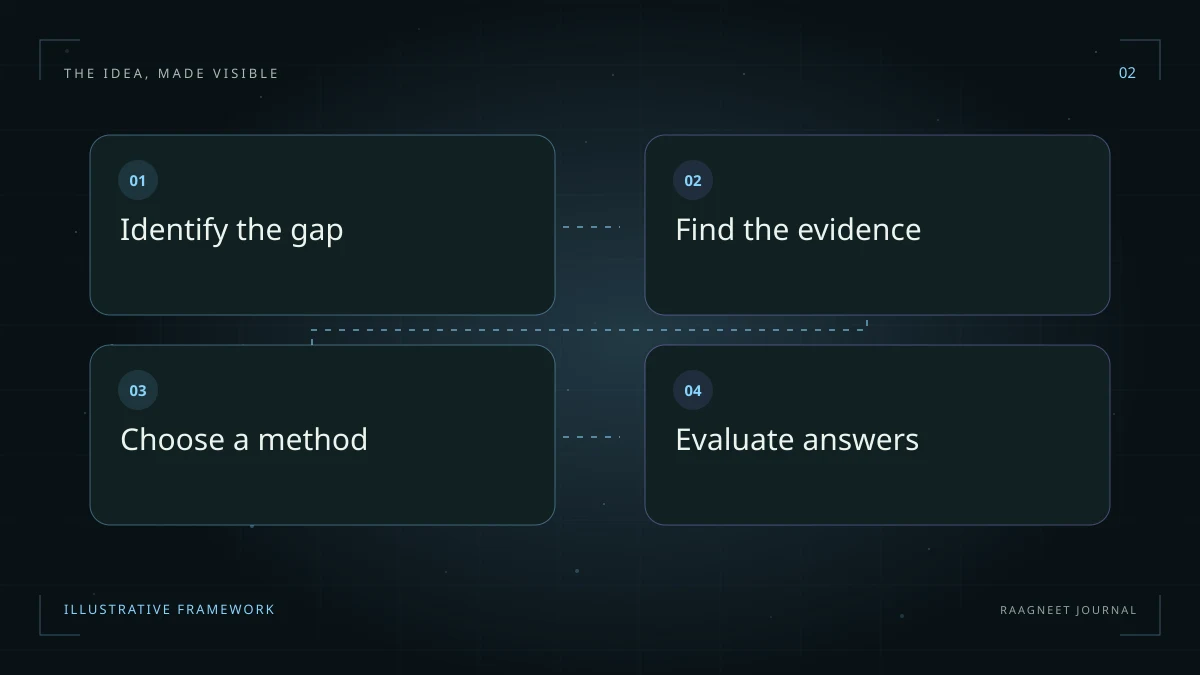
Collect questions that expose your current system's weaknesses. Mark whether each failure came from missing knowledge, poor retrieval, an unclear instruction, or a task the model cannot perform reliably. Fixing a missing document through fine-tuning may be costly and difficult to verify. Fixing a formatting problem with a vector database may add needless complexity.
Try a stronger task description and a few examples first. For a small reference set, directly supplying the relevant text may be enough. Treat these as baselines so that you can see what an additional component actually improves.
04Compare the operational work
RAG needs document ingestion, sensible chunks, permissions, retrieval evaluation, and updates when sources change. Fine-tuning needs a curated dataset, separate training and evaluation sets, training infrastructure or a provider, and a plan for model updates. Neither is a one-time setup.
A hybrid architecture is possible. A tuned classifier might select a workflow while retrieval supplies the facts used in the answer. Evaluate those pieces separately: category accuracy should not hide poor evidence selection, and excellent retrieval should not excuse an answer that contradicts its source.
05Make a decision with an evidence set
Create a representative set of questions with acceptable answers and the sources needed to answer them. Compare a simple prompt, a retrieval version, and a tuned model only where the training task is well-defined. Include unanswerable requests so that refusing to guess becomes part of success.
Measure grounded correctness, useful citations, latency, maintenance effort, and cost per acceptable answer. Keep private records and copyrighted training material out of a dataset unless you have the appropriate rights and permissions. The best choice is the smallest system that solves the observed failure and can be maintained.
Common questions
Does fine-tuning keep a model up to date?
A tuned model reflects its training examples. It does not automatically learn a newly published policy or price. Retrieval is generally easier to connect to a frequently updated source of truth.
Can RAG and fine-tuning work together?
Yes. Fine-tuning can improve a specialised behaviour while retrieval supplies current evidence. Test each contribution independently so the extra complexity has a clear purpose.
Sources & further reading
Primary documentation and further reading are linked below. Examples and decision frameworks are illustrative; product capabilities can change.
Created with AI assistance for the RaagNeet Journal. This guide does not claim original product testing or benchmark results. Original illustrations by RaagNeet. Send a correction.