Many AI requests repeat the same instructions, tool definitions, or reference document. Prompt caching can reduce the work needed to process that repeated portion. Its value depends on the provider's rules and the shape of real traffic. A headline discount is less useful than knowing how often your own application achieves a valid cache hit.
01Understand what is being cached
Prompt caching reuses processing associated with a repeated prompt prefix under provider-specific rules. It is different from returning an old generated answer. The system still generates a response for the current request, and new content can affect that response. [1]
Read the selected provider's current requirements for minimum lengths, cache lifetime, supported models, and billing. Some systems offer explicit cache controls; others manage reuse differently. Do not copy configuration from an old SDK example without checking the current API and model compatibility.
02Separate stable tools from dynamic context
Tool definitions can be a substantial repeated part of an agent request. Keeping supported tools and shared instructions stable can improve reuse, while inserting a new timestamp or changing their order near the beginning may prevent the intended cache match. Exact behaviour depends on the provider. [2]
For an illustrative support assistant, shared policy instructions can precede the current customer's question. Do not move private customer data into a broadly shared prefix merely to improve hit rates. Cache organisation must preserve the same account and data boundaries as the rest of the application.
03Estimate savings from actual request shapes
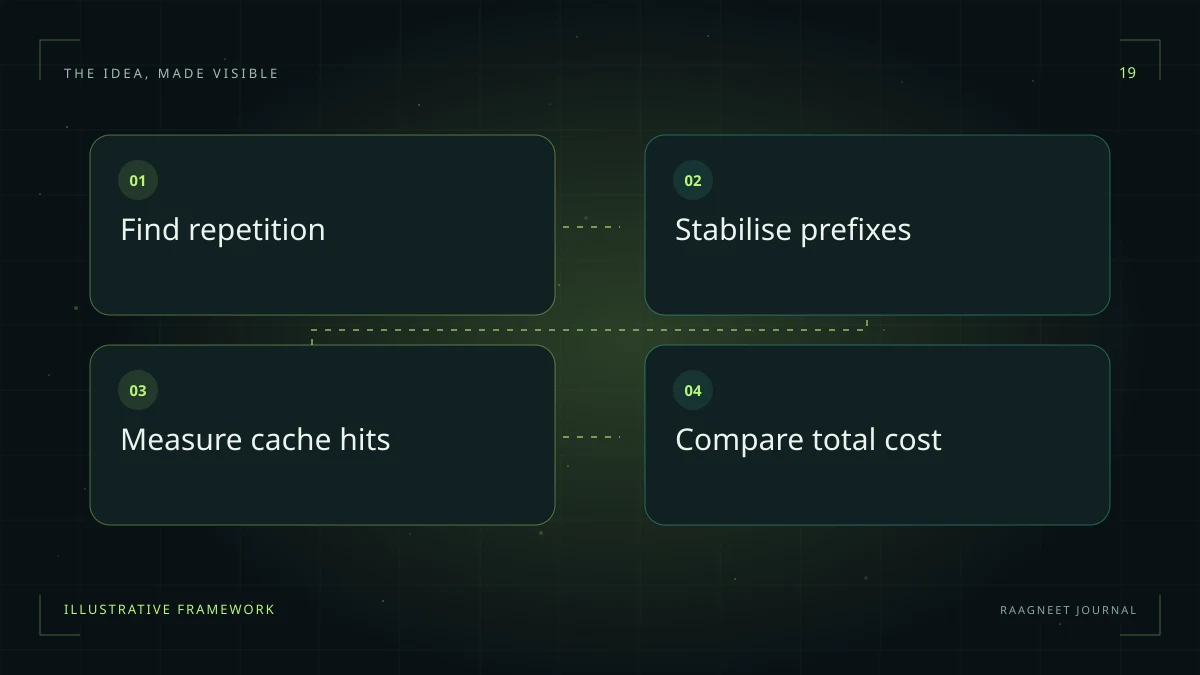
Collect usage metadata for a representative traffic sample. Record cache creation, cache reads, uncached input, generated output, retries, and the selected model. Compare total cost for the same useful workload with and without the cache arrangement.
A support tool receiving frequent similar requests may behave differently from a low-traffic internal assistant whose cache expires between uses. Large output costs or frequent tool calls may also limit the portion of the bill that prompt caching can change. Calculate the whole request rather than one discounted line item.
04Keep updates and invalidation deliberate
When a shared policy changes, make sure new requests use the new text. Version stable prefixes and keep that version in diagnostic records. A cache should not encourage a team to keep outdated instructions unchanged for the sake of reuse.
Test a changed system instruction, a modified tool schema, and a document update. Confirm that the application receives the intended behaviour after each change. Treat an unexpectedly low cache-hit rate as an operational clue, not a reason to reorder sensitive information without reviewing the consequences.
05Optimise only after measuring quality
Prompt caching can reduce repeated processing, but it does not make irrelevant context useful. Remove unnecessary material and evaluate whether a shorter, clearer request improves correctness or latency before adding more content to reach a caching threshold.
Keep a fallback for cache misses and provider outages. The uncached path should remain correct and have an acceptable upper cost limit. Review the setup when models, tool definitions, or traffic patterns change. A useful optimisation is one that reduces measured cost while preserving the application's quality and data-handling requirements.
Common questions
Is prompt caching the same as caching answers?
No. Prompt caching reuses processing for repeated input context. Response caching stores a prior output and may return it again, which creates different freshness and privacy considerations.
Will prompt caching always reduce my AI bill?
No. Savings depend on eligible input, repetition, cache lifetime, write and read pricing, output costs, and traffic. Measure total workload cost using current provider billing rules.
Sources & further reading
Primary documentation and further reading are linked below. Examples and decision frameworks are illustrative; product capabilities can change.
Created with AI assistance for the RaagNeet Journal. This guide does not claim original product testing or benchmark results. Original illustrations by RaagNeet. Send a correction.