There is no useful overall winner until you define the job. A company building a support assistant, a developer repairing a production bug, and a researcher checking contradictory sources need different evidence. This comparison treats GPT-6.2, Gemini 4 Neon and Claude Fable 5.2 as candidates for a purchase decision, rather than converting three unrelated vendor benchmark tables into a fictional league table.
01What exactly are you comparing?
OpenAI offers Astra and Sol within GPT-6.2; Google positions Neon for professional workflows; Anthropic positions Fable 5.2 for demanding technical work. Those are vendor descriptions, not results from our own tests. [1]
A fair comparison names the exact model, reasoning setting and application. An assistant with repository access is solving a different problem from a bare API receiving one pasted file. Write those conditions beside every result you record.
02For coding, measure the whole change
Use an actual issue from a disposable copy of your repository. Ask each candidate to explain the failure, make the smallest useful change and verify the affected behavior. Include a bug whose cause spans more than one file.
Score the final diff for correctness, unnecessary edits, maintainability and regression risk. A response that sounds confident but leaves a failing route is unfinished. Give credit for identifying a missing prerequisite instead of inventing a successful test run.
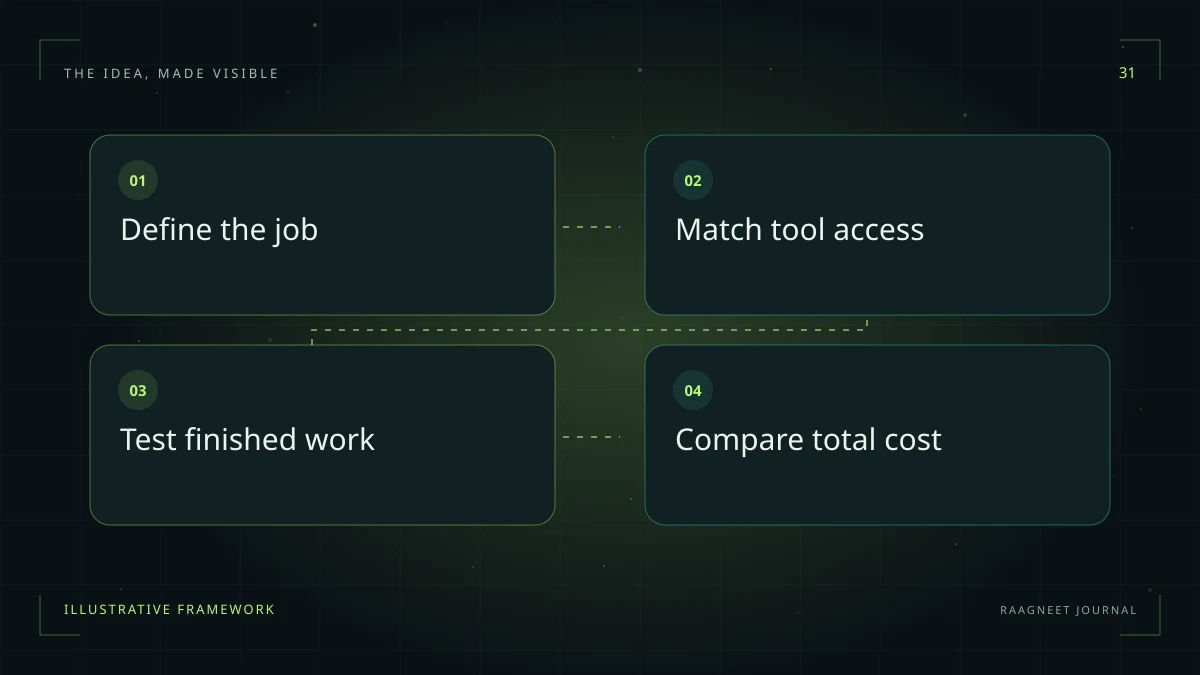
03For research, audit the evidence chain
Prepare a question with conflicting dates and at least one inaccessible document. Require sources beside material claims and ask the assistant to separate reported facts from its interpretation. Then open the cited pages yourself.
Check whether citations support the exact sentence, whether the model notices uncertainty and whether a summary preserves exceptions. Long answers and large context windows are useful only when the resulting explanation remains faithful to the underlying material.
04For business use, calculate accepted-task cost
Token prices are one input. Add repeated attempts, search or execution tools, integration development and the time someone spends checking outputs. Compare a small recurring workflow before estimating a company-wide saving.
For example, an enquiry assistant should produce a complete draft brief with the requested service and missing questions. Count successful briefs rather than generated messages. A model that costs less per request can still cost more per usable brief.
05Our practical buying decision
Shortlist the candidates your team can actually access and operate. Test routine work first, then an ambiguous task and a failure case. Keep the prompts and tool permissions consistent and repeat examples to reveal unstable behavior.
Choose the lowest-cost setup that meets your quality threshold. Keep another candidate for difficult exceptions if routing is easy to maintain. Revisit the decision when prices, tools or your workload change; a November decision should remain auditable next month.
Common questions
Which model is the best for every business?
None is established as best for every workload. Choose a task-specific quality threshold, test representative examples and compare the complete operating cost. This article offers a selection method, not an independently measured ranking.
Should I buy a subscription or use an API?
A subscription suits people working in an application. An API suits software integration and usage-based workloads. Compare the tools, access limits, data terms and billing model you need before treating the two purchases as interchangeable.
Sources & further reading
Primary documentation and further reading are linked below. Examples and decision frameworks are illustrative; product capabilities can change.
Researched against primary sources on 23 November 2026. Recommendations are editorial analysis, not a hands-on benchmark. Pricing and access can change. Original illustrations by RaagNeet. Send a correction.