Post-quantum cryptography is about preparing systems for attacks that sufficiently capable future quantum computers could enable. For a web team, the first useful action is usually understanding where cryptography is used and which providers control it. The migration is an infrastructure and lifecycle problem, not a reason to invent a new encryption scheme in application code.
01Understand what the standards address
NIST finalised its first three post-quantum standards in August 2024. They cover a key-encapsulation mechanism and digital signature schemes intended to withstand attacks from quantum computers. These are different functions; referring to every algorithm as an interchangeable encryption replacement obscures an important distinction. [1]
A website uses cryptography in multiple places: transport security, certificates, authentication, software signing, stored data, and external services. The organisation may control some layers directly while a browser, CDN, hosting provider, or payment service controls others.
02Separate final standards from selections
NIST's documentation distinguishes published standards from algorithms selected for further standardisation. A selected candidate is not automatically a final drop-in replacement. Check the status and the supported protocol implementation before treating an announcement as a migration instruction. [2]
The practical implication is to ask a provider which standard and protocol version it implements, whether the feature is generally available, and how compatibility is handled. A marketing claim of quantum-safe support needs an explanation of the protected connection or artifact and its limits.
03Map the data lifetime
Some information only needs confidentiality briefly; other records remain sensitive for many years. The concern often called harvest now, decrypt later is that an adversary could collect encrypted traffic today and attempt to decrypt it when stronger capabilities become available.
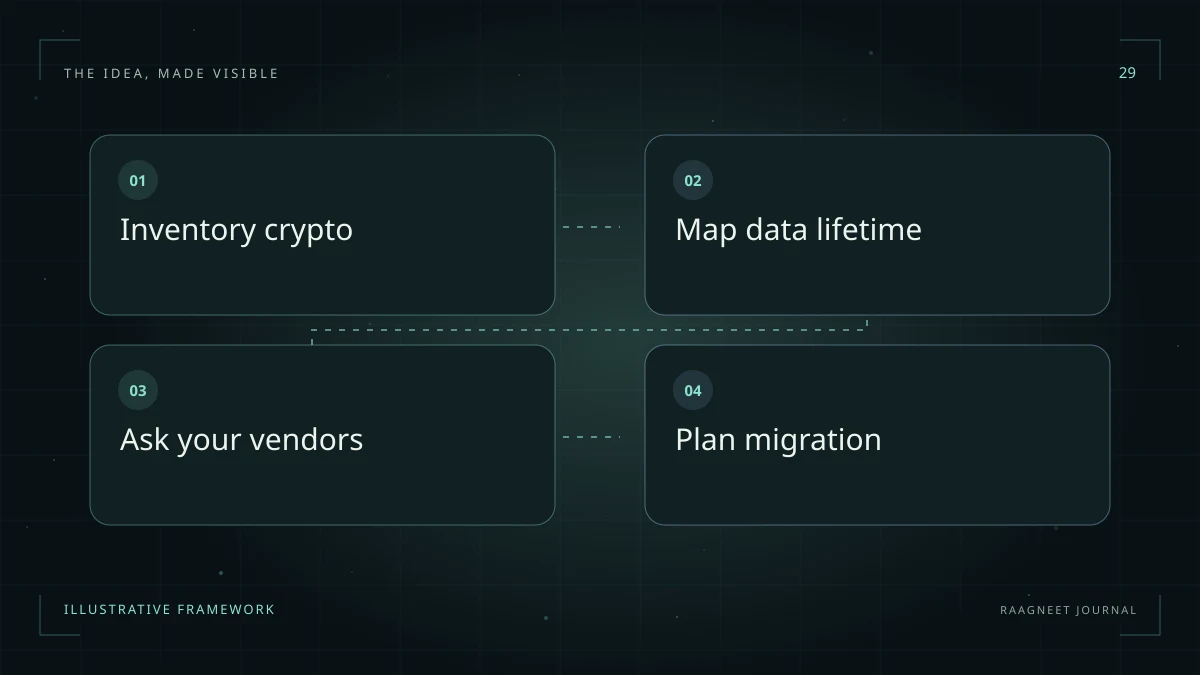
Build an inventory of sensitive data flows and retention periods with the relevant security owner. This is a proposed planning exercise, not a claim that any particular organisation is exposed. Use that inventory to prioritise discussions about transport, archives, backups, and external data processors.
04Prepare a migration through supported components
Keep cryptographic libraries, TLS infrastructure, browsers, and hosting components maintained. Ask vendors about supported post-quantum or hybrid protocol options, rollout plans, observability, and compatibility. Test connection behaviour, performance, certificates, and rollback where you control the deployment.
Do not substitute a new algorithm into a protocol without understanding the protocol's requirements. Key establishment, authentication, serialization, and negotiation interact. Use established implementations and current standards guidance, and involve qualified security specialists for production changes affecting sensitive systems.
05Make cryptographic agility maintainable
Record which algorithms and libraries a service depends on, who owns the configuration, and how updates reach production. Keep enough flexibility to change supported components without redesigning the entire application. An inventory that no one maintains becomes less useful as infrastructure evolves.
For most website teams, the immediate work is preparation: identify dependencies, ask specific vendor questions, update supported software, and plan tests. Avoid making absolute security promises. Post-quantum migration is one part of broader security maintenance, alongside access control, patching, key management, and incident response.
Common questions
Do websites need to build their own post-quantum encryption?
No. Use supported protocol and library implementations through a reviewed deployment plan. Custom cryptography is not a sensible shortcut for a website project.
Is every announced post-quantum algorithm already a final standard?
No. Standardisation has multiple stages. Check NIST and the implementation documentation to distinguish final standards, selected candidates, drafts, and deployed protocol support.
Sources & further reading
Primary documentation and further reading are linked below. Examples and decision frameworks are illustrative; product capabilities can change.
- NIST: First three finalised post-quantum standards
- NIST CSRC: Post-Quantum Cryptography Standardization
Created with AI assistance for the RaagNeet Journal. This guide does not claim original product testing or benchmark results. Original illustrations by RaagNeet. Send a correction.