Predictions are most useful when they help a team prepare without pretending the future is settled. The scenarios in this article are editorial forecasts based on current product directions, not confirmed 2027 announcements. They focus on decisions developers and businesses can make now: keeping integrations adaptable, measuring useful work and identifying the signals that would justify a larger investment.
01Prediction: more deliberate model routing
Google's Hydrogen announcement describes multi-model orchestration, and OpenAI's integration guide highlights conversation-state considerations. These present-day details suggest a plausible future with more routing across tasks, but they do not guarantee a particular 2027 product or price. [1]
Prepare by separating model configuration from business logic. Keep task inputs and acceptance criteria stable enough to compare candidates. The signal to watch is whether routing improves complete accepted-task cost without introducing excessive debugging and operational complexity.
02Prediction: evaluations become routine infrastructure
As teams change models more frequently, a reusable evaluation set may become as important as a conventional software regression suite. This is a forecast about engineering practice, not a claim that all organisations already work this way.
Start with a small collection of representative inputs and known failure cases. Preserve configuration and reviewer notes with each run. The useful signal is whether this process catches a regression before customers do, rather than how impressive the evaluation dashboard appears.
03Prediction: review shifts toward evidence
If assistants produce more implementation and analysis, reviewers may spend more time checking claims, constraints and tool actions. That could increase the value of clear logs and verifiable artifacts relative to polished conversational summaries.
Prepare by requiring concise evidence for completed work: the actual diff, calculation, source or test result. Measure whether reviewers can understand and correct mistakes faster. Avoid replacing one unreadable wall of prose with another generated report that adds little operational clarity.
04Prediction: physical workflows expand unevenly
Google's robotics tooling provides an example of AI assistance reaching hardware workflows. The extent of adoption in 2027 will depend on equipment, integration, supervision and the consequences of failure. Software progress alone does not determine deployment speed.
For businesses, begin with controlled experiments and environment-specific acceptance criteria. The signal to watch is repeatable completion under realistic variation, including recovery from mistakes. A successful staged demonstration should lead to more testing, not an assumption of unrestricted readiness.
05How to plan without betting the business
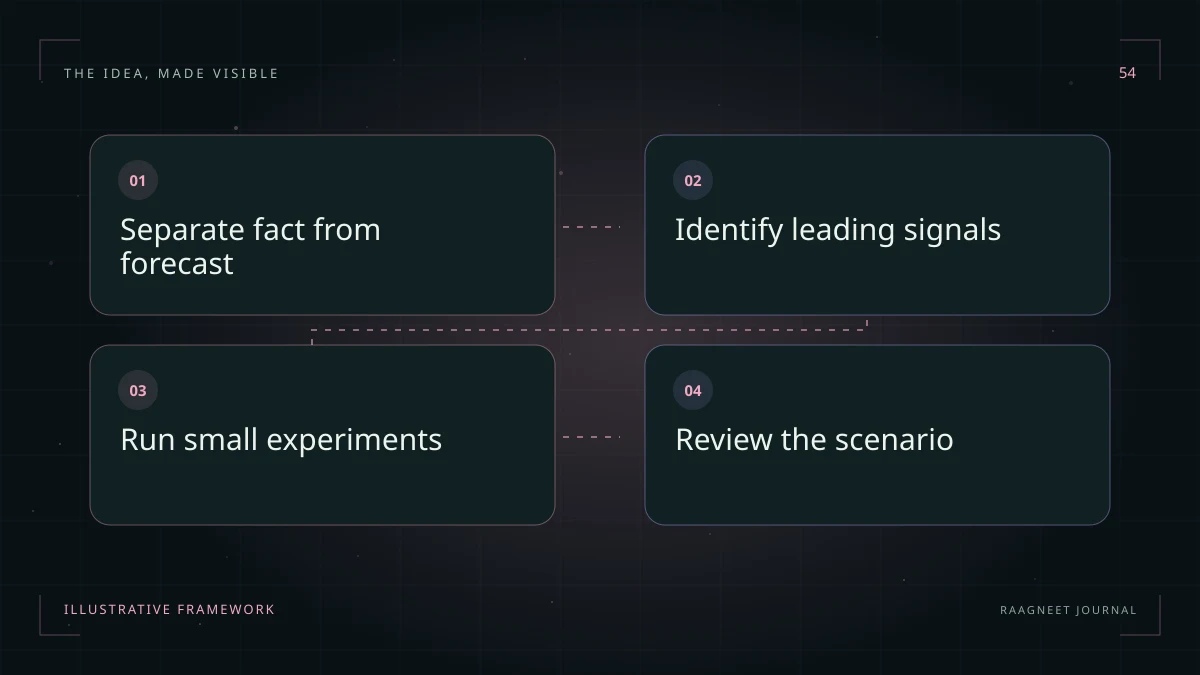
Use a conservative scenario where present tools improve gradually, an accelerated scenario where task quality improves materially and a constrained scenario where access or economics disappoint. Identify which investments remain useful across all three.
Portable data, documented processes, evaluation examples and clear ownership are good candidates for durable work. Revisit the scenarios quarterly using observed product and business results. The goal is to be ready to adopt useful capabilities, while avoiding commitments that require a speculative release to succeed.
Common questions
Are these confirmed AI releases for 2027?
No. They are scenarios and editorial predictions based on current directions. Check official announcements before budgeting for a named product or promised capability. The planning recommendations are intended to remain useful even when the forecasts change.
What can a small business do now?
Document a recurring workflow, measure its current effort and test a bounded improvement. Preserve the data and evaluation criteria so you can compare future tools. Avoid a large purchase whose business case depends entirely on an unannounced capability.
Sources & further reading
Primary documentation and further reading are linked below. Examples and decision frameworks are illustrative; product capabilities can change.
Researched against primary sources on 23 November 2026. Recommendations are editorial analysis, not a hands-on benchmark. Pricing and access can change. Original illustrations by RaagNeet. Send a correction.