AI becomes useful in everyday life when it removes a specific source of friction: finding information, completing a form or understanding an unfamiliar interface. The fifteen technologies below are organised by practical situations rather than a ranking of futuristic promises. Some are product categories you can evaluate today; others depend heavily on access, integration or hardware. None should be treated as inevitable or equally mature.
01Understanding information: technologies 1–3
The first three categories are document assistants, multimodal search and personal knowledge retrieval. Google's Neon announcement discusses work across varied inputs. That supports investigating these workflows, but it does not guarantee that every product understands your files accurately. [1]
A practical evaluation might ask an assistant to locate a policy exception in a source packet, compare a chart with its supporting table and retrieve a previously saved decision. Check the source passage and date for every important answer. Missing evidence should remain visible.
02Getting work done: technologies 4–6
The next categories are coding assistants, structured workflow agents and meeting-to-action drafting. Each can reduce preparation work when the output has a clear review path. Keep drafting a task separate from authorising it to send messages or alter shared records.
Try a bounded example such as converting a meeting note into a draft task list. Check owners, dates and unanswered questions. The useful product preserves uncertainty and asks for missing decisions instead of quietly turning a tentative suggestion into an organisational commitment.
03Access and communication: technologies 7–9
Translation assistance, speech interfaces and adaptive reading tools may help people access information in a form that suits them. Evaluate the specific language pair, audio environment or document format rather than assuming performance transfers from a polished demonstration.
For important communication, retain the original source and a way to request human clarification. Consider latency, correction controls and whether the interface makes errors obvious. A feature is more accessible when users can inspect and repair its output, not merely receive it quickly.
04Everyday services: technologies 10–12
Shopping guidance, customer-support triage and learning assistants can help with common decisions. Their usefulness depends on accurate source material and clear limits. A support assistant should recognise when account access or a human decision is needed instead of inventing a resolution.
For learning, test whether the assistant explains the reason behind an answer and adapts when a learner makes a mistake. For shopping, examine whether recommendations follow the stated requirements. Disclosure and source quality matter when commercial incentives could influence the suggested choice.
05Physical and operational systems: technologies 13–15
Robotics assistance, maintenance analysis and operational simulation extend the idea beyond chat. Google's robotics post describes Hydrogen-related tooling, but a software demonstration is not proof that a robot is ready for unrestricted operation in a particular workplace.
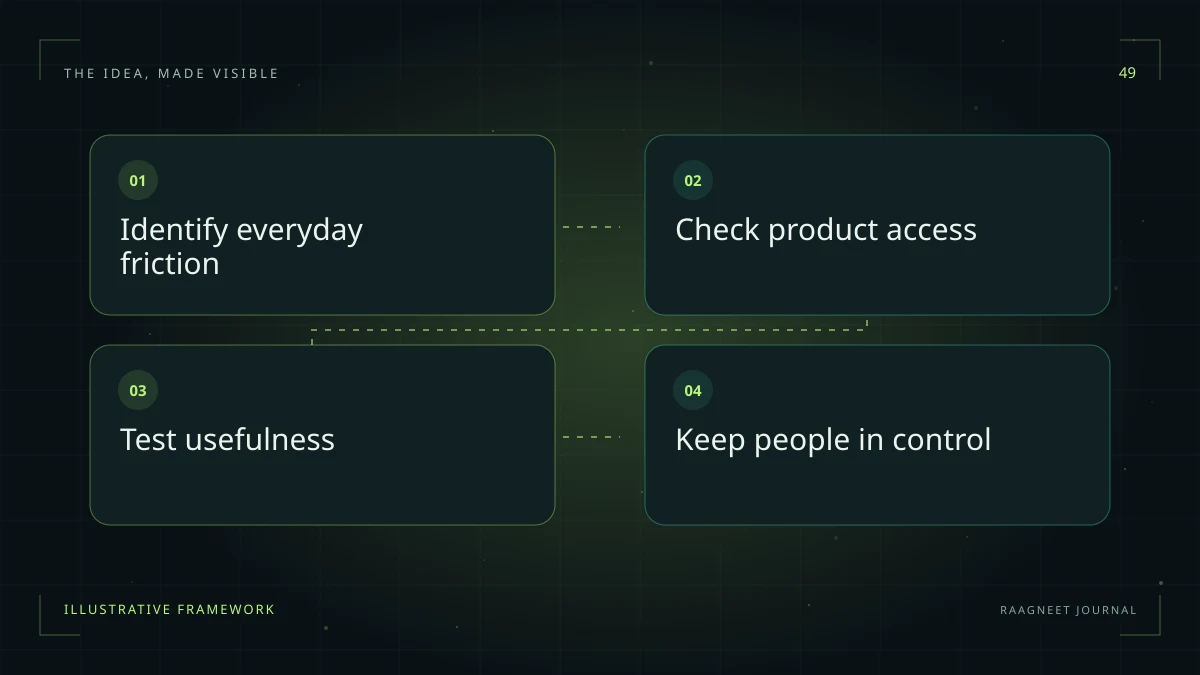
These systems need environment-specific testing, appropriate supervision and clear ownership. Evaluate a small controlled task before extending authority. Across all fifteen categories, the durable question is the same: what activity improves, how is the result checked, and what happens when the system fails?
Common questions
Are all fifteen technologies mature products?
No. They are practical categories with different levels of readiness, access and integration effort. Verify the actual product and supported task before purchasing. A category's potential does not establish that a particular implementation is reliable.
Which category should a small business explore first?
Start with a recurring information or preparation problem whose output is easy to review. A document brief or enquiry draft may provide a clearer pilot than an open-ended autonomous system with many external actions.
Sources & further reading
Primary documentation and further reading are linked below. Examples and decision frameworks are illustrative; product capabilities can change.
Researched against primary sources on 23 November 2026. Recommendations are editorial analysis, not a hands-on benchmark. Pricing and access can change. Original illustrations by RaagNeet. Send a correction.