Choosing between MAI Code 2 and GPT-6.2 is partly a model decision and partly a workflow decision. Your team needs access, repository context, suitable permissions and an output reviewers can maintain. This guide focuses on everyday engineering work and explains which evidence is useful when evaluating a new coding model against an existing OpenAI-based setup.
01Understand Microsoft's stated focus
Microsoft describes MAI Code 2 around production code, debugging and multi-file work. Its announcement distinguishes that focus from harder science and very long-horizon tasks. This is vendor positioning; it is not a universal ranking against all GPT-6.2 configurations. [1]
Before evaluating, name the exact OpenAI model and the environment used by each candidate. A comparison against an unspecified GPT-6.2 setting is difficult to reproduce. Record access to terminals, dependency installation, browser checks and project instructions.
02Evaluate enterprise fit first
Confirm that the model can be used through an approved platform with suitable access and billing. Consider whether it fits existing repository permissions, audit requirements and development policies. A model that needs a major tooling change carries costs beyond token usage.
Check how the workflow handles private code, logs and external tools. Decide which repositories and actions the assistant can access. Permissions should be enforced by the environment so that an instruction in a file cannot silently expand the assistant's authority.
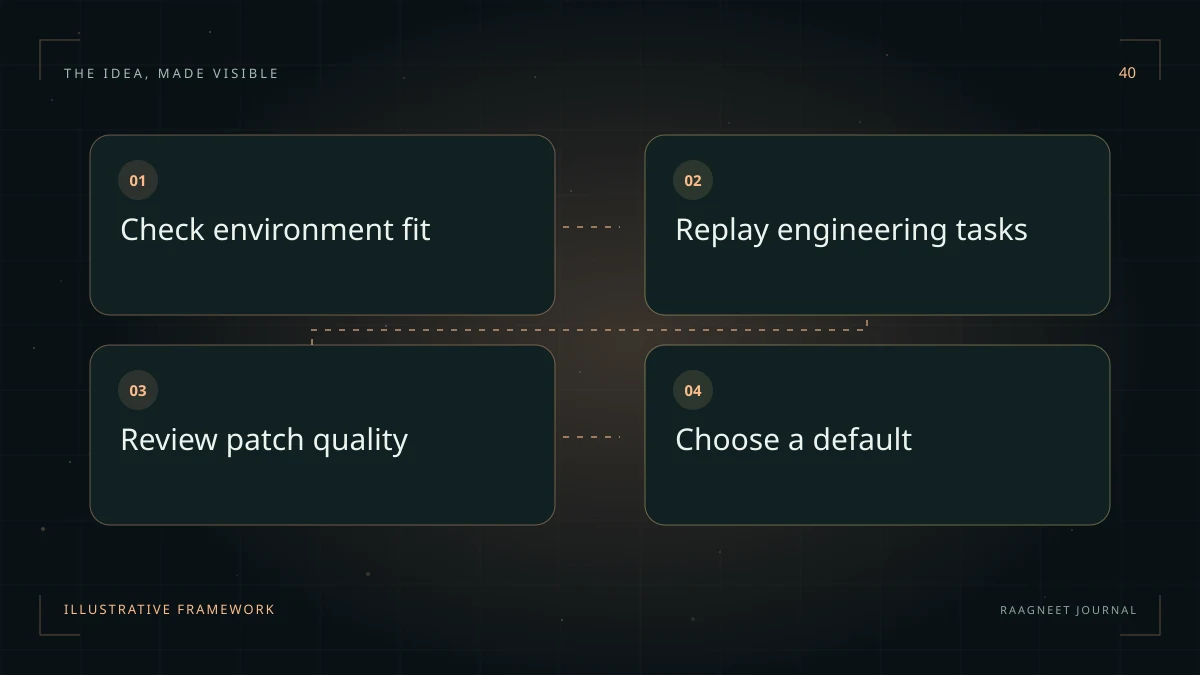
03Test common engineering work
Select a database mapping bug, a UI regression and a multi-file feature. Include acceptance criteria and the same source commit. Ask each candidate to reproduce the problem before changing it, then inspect whether the final patch solves the observed behavior.
Keep track of scope creep. A broad rewrite can obscure a small fix and increase review burden. For an enterprise team, a modest patch with clear reasoning and reliable verification may be more useful than a dramatic implementation that no one wants to merge.
04Examine failure recovery
Introduce a failed check or an unavailable dependency in a disposable environment. Observe whether the assistant diagnoses the issue, reports it accurately and avoids fabricating a clean result. Good recovery matters because real repositories rarely provide a perfect first-run setup.
Review whether retries preserve state correctly. An assistant should not recreate resources or repeat writes just because a tool response was unclear. Recovery behavior affects both engineering safety and the amount of supervision needed during ordinary development.
05Choose based on accepted changes
Summarise outcomes by task type and record total completion time, usage and reviewer corrections. Distinguish a failure caused by the model from one caused by missing tooling. Repeat the tasks before making a default-team recommendation.
Prefer the option that meets your team's quality bar with a manageable operational footprint. Keep an alternative for the cases where it demonstrably helps. A short evaluation record is more useful for future purchasing decisions than a ranking built around one successful demonstration.
Common questions
Is MAI Code 2 a replacement for all GPT-6.2 use?
That is not established by its coding focus. A developer workflow may also require research, document analysis or other tasks. Evaluate each requirement and name the exact model and tools used in the comparison.
Should our team switch immediately after a new release?
Run a limited pilot first. Check approved access, task quality and reviewer burden. Keep the existing route available until the replacement has demonstrated the behaviors your production engineering workflow depends on.
Sources & further reading
Primary documentation and further reading are linked below. Examples and decision frameworks are illustrative; product capabilities can change.
Researched against primary sources on 23 November 2026. Recommendations are editorial analysis, not a hands-on benchmark. Pricing and access can change. Original illustrations by RaagNeet. Send a correction.