Microsoft's MAI Code 2 family gives developers another candidate for coding workflows, but a new model family is useful only if it fits the team's repository, tools and review process. Code 2 and Flash should be assessed as choices for different kinds of work. This guide explains the documented distinctions and a practical path from announcement to a limited, measurable engineering pilot.
01What the model card documents
Microsoft's model card lists text and image inputs, text output and a 1.05-million-token context length for both variants. It describes Code 2 as larger and Flash as smaller, with a common architecture family and training lineage. [1]
These specifications describe capacity and design, not your team's expected productivity gain. A large context allowance does not guarantee that the assistant finds the relevant file, understands a business rule or produces a change reviewers are willing to merge.
02Where Code 2 belongs in a pilot
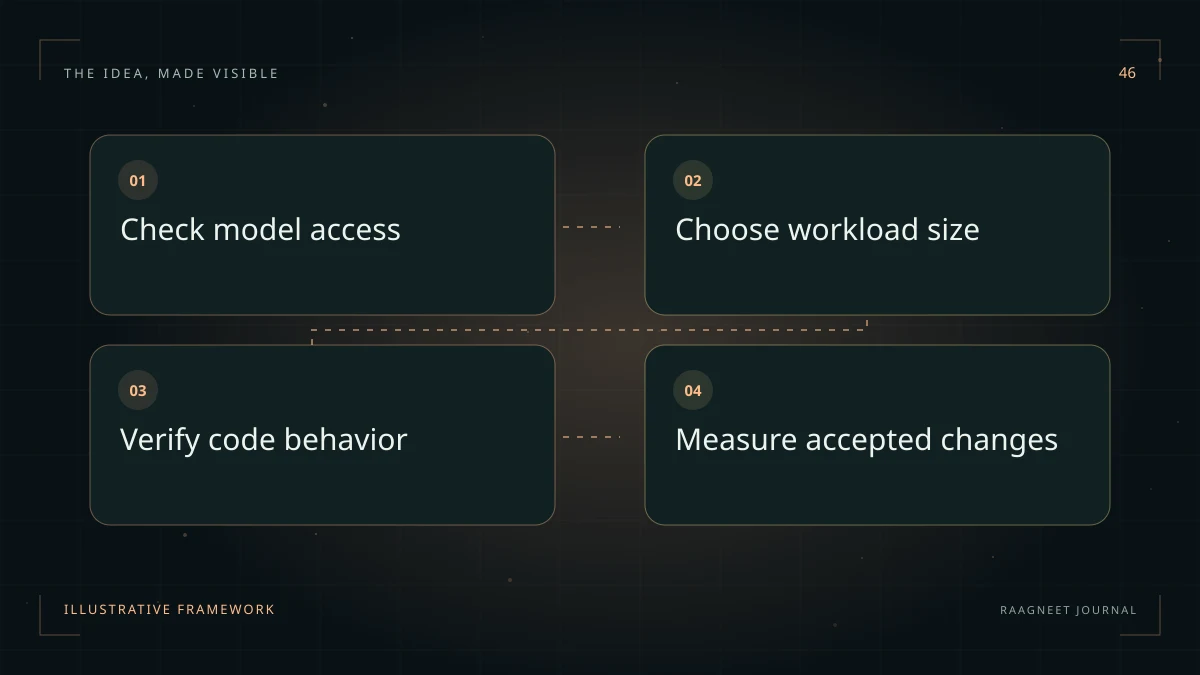
Choose tasks that benefit from repository-level investigation, such as a bug spanning several modules or a feature that changes an interface contract. Provide the reproduction and compatibility requirements without dictating an unverified implementation.
Inspect whether the model finds the root cause and limits its patch to useful changes. A broad diff may appear productive while imposing unnecessary review. Ask for the exact verification performed and check the evidence against the repository state.
03Where Flash belongs in a pilot
Use routine tasks with clear acceptance criteria: a narrow validation fix, a code explanation or an edit whose behavior can be tested quickly. These tasks reveal whether a lighter workflow is sufficient without requiring a model to solve an open-ended architecture problem.
Keep the quality bar unchanged. A lower-cost option should not receive automatic acceptance merely because the task looks small. Short patches can affect important paths, so meaningful validation and code review remain part of the workflow.
04Check integration before standardising
Confirm the supported platform, model identifier, billing route and availability for your account. Evaluate whether the environment can run your build and tests and follow local project instructions. A model without suitable tools may need a different operational setup.
Document data access and allowed actions. Separate read-only investigation from changes that publish software or alter external records. Tool permissions should enforce the boundary so the assistant can work effectively without receiving unnecessary access to the rest of the organisation.
05Decide from a repeatable trial
Run both variants against a representative task set and keep accepted diffs, usage records and reviewer corrections. Group results by difficulty. This exposes whether the larger option earns its place on a specific class of work rather than every request.
Roll out gradually if the pilot supports adoption. Keep the previous setup available and assign someone to review regressions. A dependable model strategy includes monitoring and a change history, not just an initial decision based on launch-day descriptions.
Common questions
Are Code 2 and Flash identical apart from price?
The model card describes different model sizes within the same family. Evaluate task quality and completion behavior separately. Do not assume a smaller variant produces identical results or that the larger one improves every routine request.
Can we rely only on benchmark scores?
No. Benchmarks help frame a shortlist but may use different tools, tasks and review criteria. A repository pilot should examine accepted changes, regression risk and reviewer effort under the conditions your team will actually use.
Sources & further reading
Primary documentation and further reading are linked below. Examples and decision frameworks are illustrative; product capabilities can change.
Researched against primary sources on 23 November 2026. Recommendations are editorial analysis, not a hands-on benchmark. Pricing and access can change. Original illustrations by RaagNeet. Send a correction.