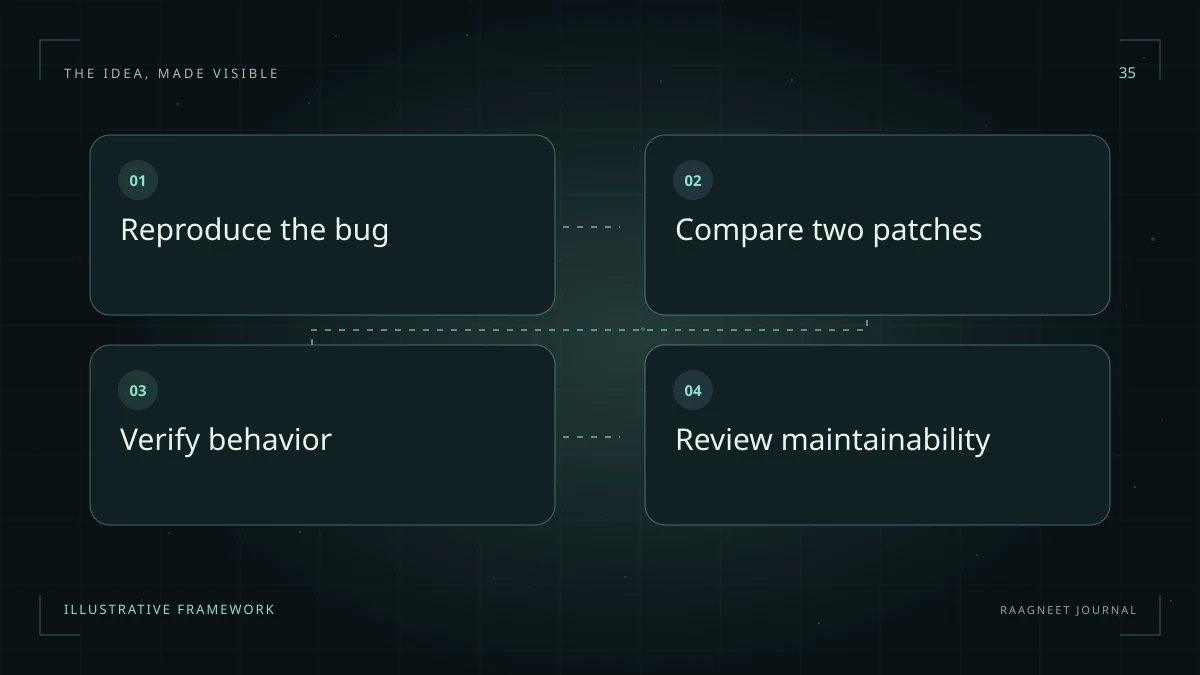
A credible real-world coding comparison needs real repository tasks and a record of what happened. We have not run a controlled head-to-head benchmark of Fable 5.2 and Astra for this article. Instead, this guide gives engineering teams a reproducible method to evaluate them on their own code, including the difficult review work that a leaderboard score cannot reveal.
01Set a fair starting point
Anthropic positions Fable 5.2 for ambitious engineering, while OpenAI positions Astra for demanding projects. Those statements justify a shortlist. They do not establish which candidate will repair your application's specific failure more reliably. [1]
Prepare two clean copies of a repository at the same commit. Install identical dependencies and supply the same project instructions. Match the allowed tools and network access. Differences in the coding harness can otherwise be mistaken for differences in the model.
02Use tasks with observable failure
Choose a bug that can be reproduced, a feature with a clear contract and a refactor with existing behavior to preserve. Include at least one task whose apparent fix would hide the symptom without addressing the cause.
Write acceptance criteria before either model starts. For a broken checkout, that might mean correct totals, a handled payment failure and no duplicate order creation. A vague instruction to improve quality leaves too much room for a persuasive but irrelevant solution.
03Review reasoning through artifacts
You do not need access to private reasoning to assess engineering judgment. Inspect the reproduction, patch, checks and explanation. A useful assistant identifies the causal path and ties each material change to the requested behavior.
Penalise disabled checks, invented test results and broad unrelated rewrites. Also inspect whether the model recognises a blocked dependency or missing credential. Honest partial completion with a precise blocker can be safer to finish than a confident report that the code contradicts.
04Measure collaboration and correction
After the initial patch, introduce one realistic correction such as a compatibility requirement. Observe whether the model updates the right parts without undoing the fix. This tests collaboration that often matters more than the first generated answer.
Record how much reviewer time the change needs and how often the task must be restarted. If a model produces a larger diff, count the extra review surface. More generated code is not automatically more delivered value.
05Turn the trial into a purchase decision
Repeat the tasks and preserve the resulting diffs. Classify outcomes as accepted, repairable or rejected using the criteria you wrote earlier. Summarise the error categories alongside usage and elapsed time so the conclusion can be challenged.
Choose a default only after the evidence supports it for your workload. Keep separate conclusions for frontend work, backend integration and deep debugging when those differ. Avoid publishing a universal winner from a handful of handpicked successes.
Common questions
Does this article report hands-on benchmark results?
No. It is a source-informed evaluation guide with proposed tasks and scoring criteria. It does not claim measured success rates, latency figures or a tested winner for Fable 5.2 versus Astra.
Should a passing test suite decide the winner?
It is necessary evidence where tests apply, but it is incomplete. Check the test quality, actual product behavior, compatibility and maintainability. A model can satisfy narrow tests while missing the user-facing requirement.
Sources & further reading
Primary documentation and further reading are linked below. Examples and decision frameworks are illustrative; product capabilities can change.
Researched against primary sources on 23 November 2026. Recommendations are editorial analysis, not a hands-on benchmark. Pricing and access can change. Original illustrations by RaagNeet. Send a correction.