AI coding models can complete substantial implementation tasks, but saying they are better than human developers mixes several different claims. Writing a function, diagnosing a production failure and deciding what a product should do are not equivalent tests. A useful comparison defines the task, quality standard and surrounding tools, then measures the whole process through review and delivery rather than counting generated code.
01Read the productivity evidence in context
METR's early-2025 study reported a slowdown for its experienced open-source developer sample. Its February 2026 update discusses changing the experiment and reasons newer estimates may differ. Neither source establishes a universal November 2026 verdict on all developers or models. [1]
Keep the study population, tools and tasks attached to any quoted result. An experiment on maintainers working in familiar mature repositories answers a different question from a novice creating a prototype. Both may matter, but they cannot be treated as interchangeable evidence.
02Define what better means
For a narrow task, better might mean a correct function produced quickly. For a team, it may mean maintainable changes delivered with fewer regressions. For a business, the important outcome may be a reliable feature that customers can use.
Write acceptance criteria before comparing people and tools. Otherwise a demonstration can quietly substitute code generation speed for engineering quality. Include compatibility, failure behavior and review requirements when those are part of the actual job.
03Separate implementation from judgment
An assistant may implement a clear requirement while a person decides whether that requirement is sensible. Ambiguous product work needs trade-offs about customers, constraints and ownership. Treat those decisions explicitly instead of allowing a generated implementation to settle them accidentally.
Review whether a proposed fix addresses the root cause or simply removes the failing check. Ask for a concise explanation tied to observable behavior. Correctness includes preserving the important parts of the system that were not mentioned in the initial prompt.
04Measure the assisted workflow
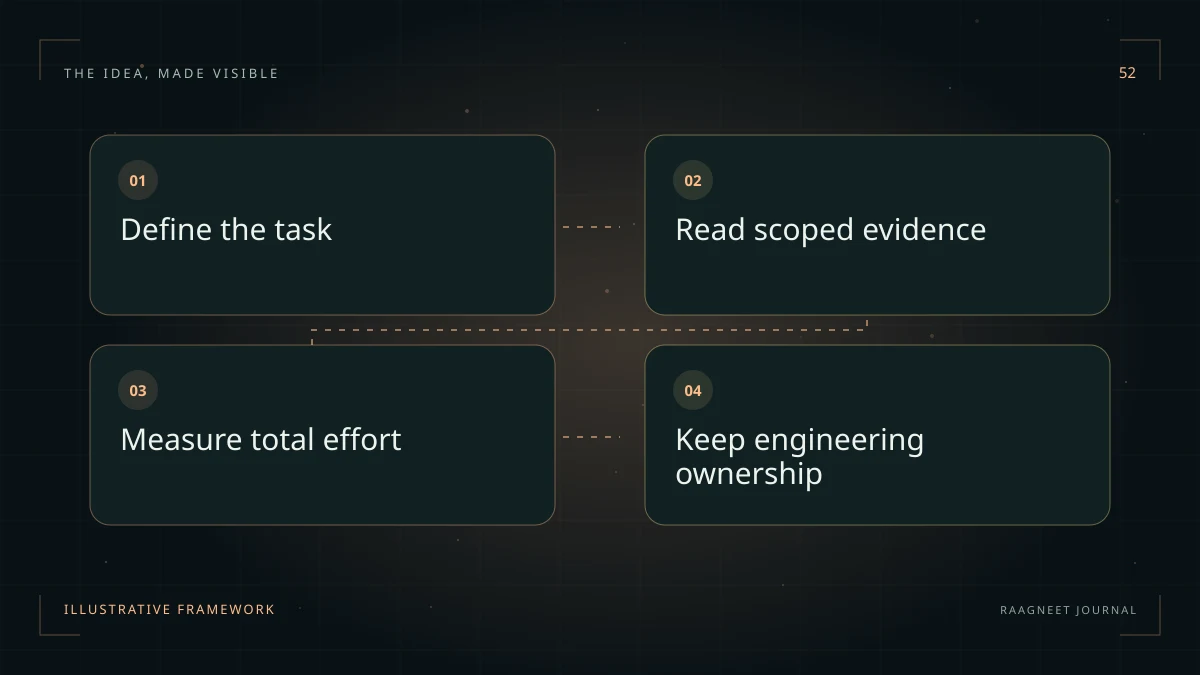
Compare complete tasks with and without assistance under conditions that reflect your team. Include setup, prompting, waiting, reviewing and repair. Record when assistance is abandoned so failed attempts do not disappear from the analysis.
Use repeated tasks across several categories and avoid judging from a favourite example. Developers may find an assistant helpful for unfamiliar APIs while preferring direct editing in well-known code. A useful rollout recognises these differences instead of imposing one universal usage target.
05Keep responsibility attached to delivery
A team can benefit from capable assistants while retaining human ownership of requirements, review and operations. Set clear release criteria and ensure someone understands the resulting change well enough to maintain it after the conversation ends.
The practical question is how to allocate work to improve the whole process. Use evidence from accepted changes and production outcomes to revise that allocation. A prediction about replacing every developer is less useful than identifying where assistance reliably reduces effort today.
Common questions
Does AI coding mean software jobs disappear?
This article does not establish an employment forecast. Task capability, team productivity and labour-market outcomes are different questions. Measure the work your organisation needs before drawing conclusions about roles from a coding demonstration.
What should a development team measure first?
Track accepted task completion, reviewer time, correction effort and regressions across representative work. Keep model and tool configurations with the results. This produces a more useful decision than counting suggestions accepted or lines of code generated.
Sources & further reading
Primary documentation and further reading are linked below. Examples and decision frameworks are illustrative; product capabilities can change.
- METR: early-2025 developer productivity study
- METR: developer productivity experiment update
- Microsoft: MAI Code 2 model card
Researched against primary sources on 23 November 2026. Recommendations are editorial analysis, not a hands-on benchmark. Pricing and access can change. Original illustrations by RaagNeet. Send a correction.