A fluent answer is easy to mistake for a correct one. Evaluating an LLM application means deciding what success looks like and collecting enough evidence to tell whether the system achieves it. The most useful tests come from actual product requirements, including the situations where the system should ask a question or decline to guess.
01Write an observable definition of success
Agent evaluations need to consider the result produced in the environment, not only the words in a transcript. A system saying that a booking succeeded is different from a valid booking actually existing. The same principle applies to search, extraction, support, and content generation. [1]
For an illustrative project-brief extractor, success can mean correctly identifying the requested service, preserving the supplied deadline, and leaving absent budget information empty. These checks are concrete enough to implement and more useful than a general impression that the output looks professional.
02Use a consistent scoring rubric
A structured evaluation can combine automated checks with a human-readable rubric. Fixed fields, required identifiers, and schema validity can be checked in code. More subjective dimensions, such as whether a summary preserves the key caveat, need carefully defined judgment and occasional human calibration. [2]
Separate correctness from style. A clear, friendly answer can still contain a wrong policy. Give each dimension its own score so an attractive tone cannot conceal a factual failure. If you use another model as a judge, compare its decisions with a trusted human sample.
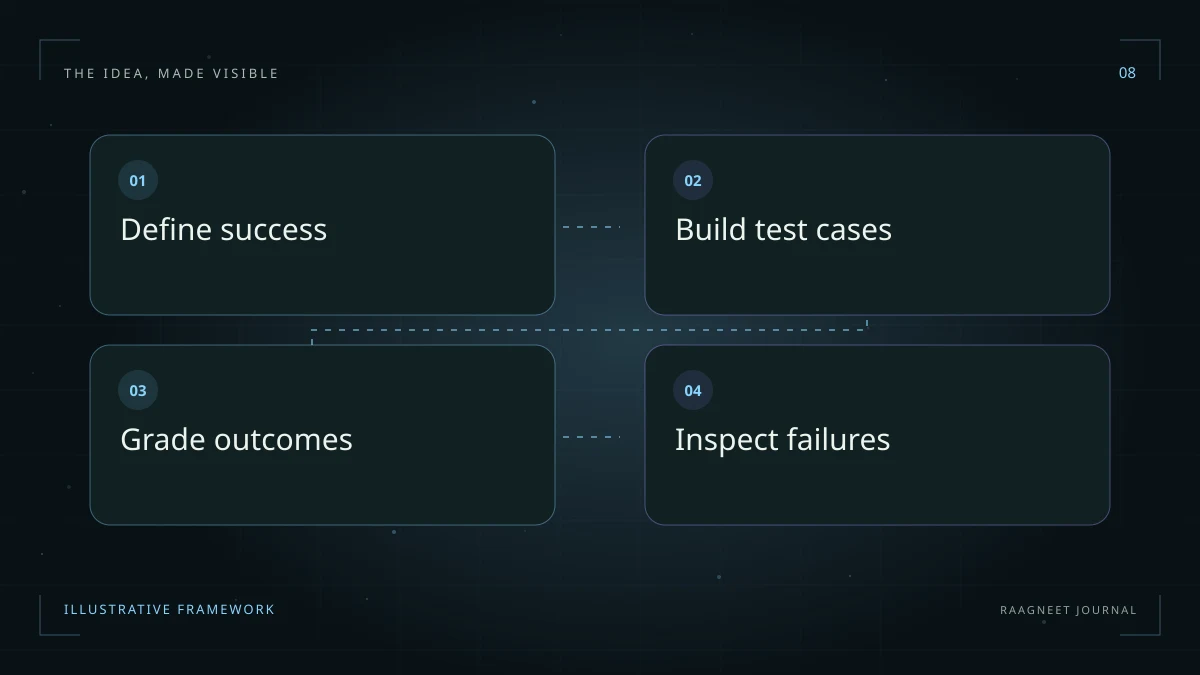
03Build cases from realistic variation
Collect inputs that represent the audience and the sources the system will see. Include incomplete requests, conflicting facts, different languages where supported, long documents, unsupported tasks, and malformed data. Keep private information out of shared fixtures through appropriate sanitisation.
Maintain a holdout set that is not repeatedly used to adjust prompts. Otherwise, the application may become excellent at your examples without improving on new requests. A production incident can become a regression case after it has been understood and safely reproduced.
04Inspect intermediate failures
For retrieval systems, check whether the right source was found before blaming the answer model. For agents, inspect tool arguments and the final state. For extraction, distinguish a parsing failure from a confidently invented value. This helps select a fix that addresses the actual cause.
Run repeated trials where output variation matters. Report the distribution of outcomes instead of presenting a single lucky response as typical behaviour. Keep the model revision, prompt version, dataset version, and runtime configuration with the results so comparisons remain meaningful.
05Set a release decision and keep learning
Choose acceptance criteria before looking at the final scores. A low-risk drafting tool can tolerate different mistakes from an assistant that modifies customer records. Track latency, cost per acceptable result, escalation behaviour, and failure severity alongside accuracy.
After launch, sample real outcomes and add newly discovered edge cases. An evaluation suite is a maintained product asset. It should become more representative over time while preserving older cases that catch regressions. Treat a perfect score on a narrow test as a reason to inspect coverage, not proof that the problem is solved.
Common questions
Is one accuracy score enough?
Usually not. Separate factual correctness, task completion, permission handling, latency, and cost. A single average can hide a severe failure affecting a small but important group of requests.
Can an LLM grade another LLM?
It can help with subjective judgments, but the rubric needs calibration against human decisions. Prefer direct programmatic checks for facts and outcomes that can be verified objectively.
Sources & further reading
Primary documentation and further reading are linked below. Examples and decision frameworks are illustrative; product capabilities can change.
Created with AI assistance for the RaagNeet Journal. This guide does not claim original product testing or benchmark results. Original illustrations by RaagNeet. Send a correction.