A support chatbot is useful when it helps someone resolve a problem with less effort. It becomes frustrating when it repeats generic answers, invents a policy, or blocks access to a person. The design challenge is to connect reliable business information with a conversational interface while keeping account access and consequential actions under control.
01Define which support work the system owns
Support tasks differ in ambiguity and consequence. Finding an installation guide is different from approving a refund. Agent design guidance highlights the value of choosing a clear task and introducing additional complexity only when simpler approaches are insufficient. [1]
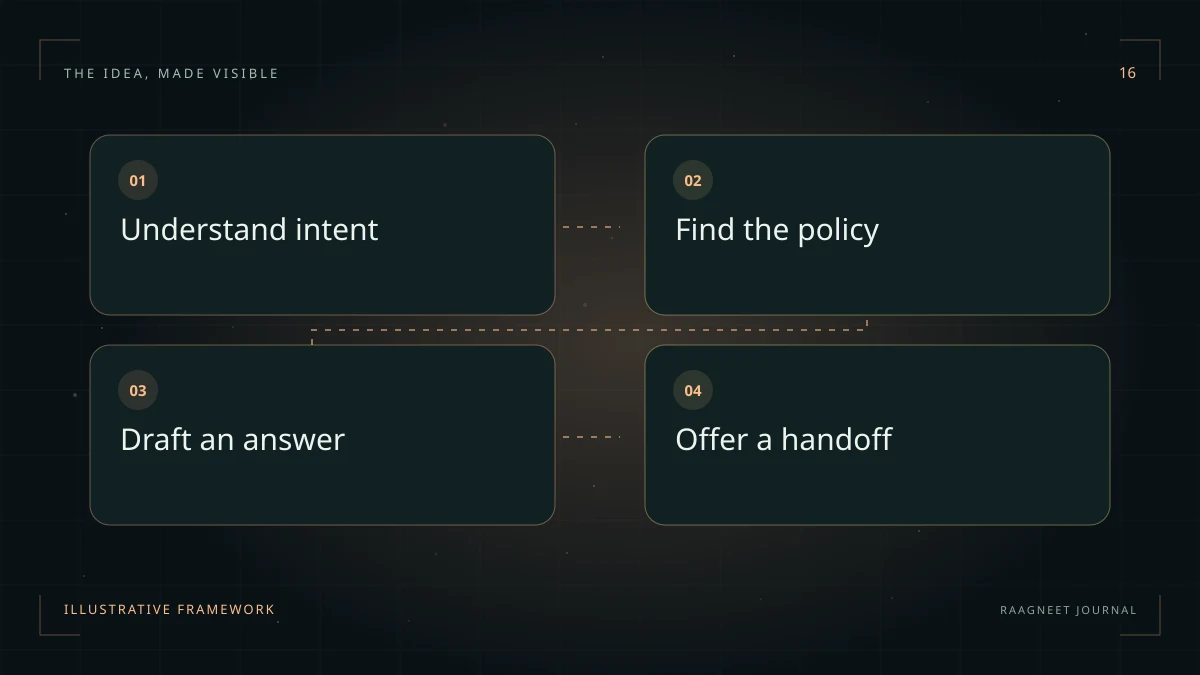
For an illustrative service business, begin with questions about opening hours, supported services, and how to submit a project brief. Keep promises about pricing exceptions or delivery guarantees outside the automated scope unless they are backed by an explicit business rule and an authorised action.
02Put account checks before retrieval
A retrieval system may search public documentation and private customer records. Those sources need different access rules. A permissions-aware design restricts which documents can be retrieved for a given identity, instead of asking the answer model to ignore material the customer should not see. [2]
Do not use a name or an email address typed into chat as sufficient proof of account ownership. Authenticate through the application's normal process and pass a server-verified identity to account tools. Keep the customer's current permission scope attached to every private lookup.
03Make evidence available to the customer
Provide a relevant source link near policy-based answers. Keep the wording clear about whether the response quotes a published policy, describes an account record, or proposes a next step. When sources conflict or a requested fact is absent, ask a question or offer a handoff.
Preserve enough context for a support colleague to continue without forcing the customer to repeat everything. Include the issue, steps already tried, and relevant record identifiers. Avoid forwarding unrelated conversation history or sensitive information that is unnecessary for resolving the case.
04Evaluate resolution rather than silence
A customer who leaves the chat has not necessarily had their problem solved. Measure verified task completion, correction rates, repeat contacts, escalation quality, and customer feedback. Keep latency and cost in the picture, but do not optimise only for reducing human handoffs.
Test outdated policies, contradictory messages, unsupported requests, account-boundary attempts, and emotional frustration. A useful support system should remain clear and respectful when it cannot act. Review real failures and update both the knowledge base and the routing rules where needed.
05Keep the service maintainable
Assign an owner for source updates, tool permissions, and incident handling. Give the team a way to disable a failing integration and route conversations to a conventional support channel. Set retention rules for transcripts and avoid collecting extra personal information simply because chat makes it easy.
Expand the chatbot's scope gradually. A dependable assistant that answers a few common questions and hands off well can create more value than an ambitious agent with unclear authority. Judge the system by the customer's ability to reach a correct result, including through a person when necessary.
Common questions
Can an AI chatbot replace all support staff?
That is not a sensible default assumption. Many cases need judgment, exceptions, or empathy. Start with a bounded scope and preserve a clear route to a person.
Should every answer include a source?
Policy and product claims benefit from relevant source links. Private account answers also need verified identity and record-level permissions; a citation alone does not establish authorised access.
Sources & further reading
Primary documentation and further reading are linked below. Examples and decision frameworks are illustrative; product capabilities can change.
Created with AI assistance for the RaagNeet Journal. This guide does not claim original product testing or benchmark results. Original illustrations by RaagNeet. Send a correction.