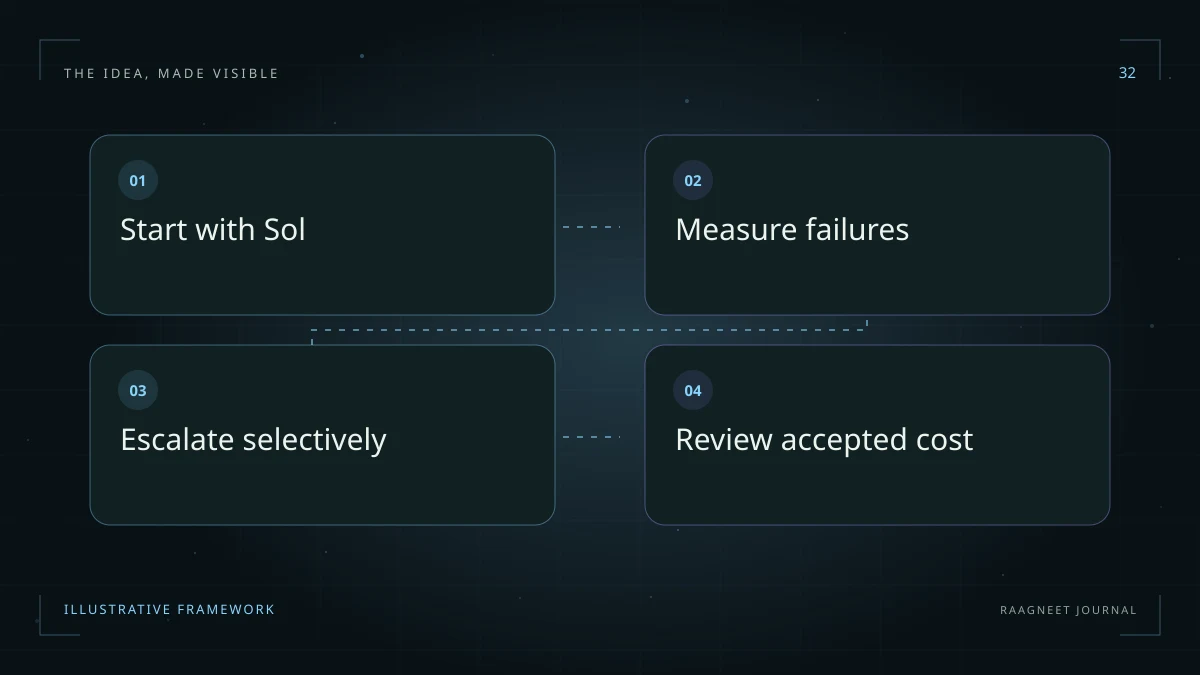
Start by testing Sol for routine work and reserve Astra for tasks where extra reasoning changes the outcome. That is a proposed routing strategy, not a claim that the cheaper model will pass your tests. The useful Astra-versus-Sol decision is whether the improvement on difficult work justifies the additional cost, latency and complexity in your actual workflow.
01Features and price: the verified baseline
The official model catalogue lists text and image input, text output and tool support for this family. It positions Astra for demanding projects and Sol for everyday work. Verify the exact endpoint and available tools when integrating. [1]
Standard API pricing is distinct from a ChatGPT subscription or a special processing tier. Do not multiply a monthly seat price by token usage. Build your estimate from the billing route you will actually use and check additional tool charges separately.
02A simple API cost example
For an illustrative request with 10,000 input tokens and 2,000 output tokens, standard token cost is $0.16 on Astra or $0.04 on Sol. This arithmetic excludes caching, tools, reasoning-token accounting differences and additional attempts.
That four-to-one request-price ratio does not establish a four-to-one project-cost ratio. If one candidate needs a second repair pass or substantially longer review, the final economics change. Record both request usage and whether the resulting work was accepted.
03Speed needs a finish line
Measure time until usable completion, rather than only time until the first token. A coding task might involve reading files, applying a patch and running a check; faster initial prose does not guarantee a faster completed change.
Use repeated runs under similar conditions and record the median plus unusually slow cases. Network conditions, selected reasoning effort and external tools can dominate elapsed time. Avoid presenting an isolated run as a universal speed claim.
04Design an escalation rule
Begin with well-defined tasks such as formatting structured information or fixing a narrowly reproduced bug. Escalate when validation fails, requirements conflict, or the work needs architectural judgment beyond the initial attempt.
Make escalation observable. Preserve the original brief, the failed validation and the attempted fix so the second model does not restart without context. Limit retries and provide a human route when neither candidate meets the acceptance criteria.
05Which should you use?
Choose Sol when it consistently passes your checks at a lower accepted-task cost. Choose Astra for a workload where a pilot demonstrates fewer important errors or less review. Keep separate evaluations for content drafting, code repair and document analysis.
For a new application, avoid hard-coding a provider-specific choice into every business function. A small model configuration layer makes future comparisons cheaper. Recheck prompts after model changes and keep a rollback route for unexpected behavior.
Common questions
Is Astra always better than Sol?
A higher capability tier is not a guarantee on every request. A narrow task may already be solved reliably by Sol. Evaluate the failure modes that matter to your application before paying more for every call.
Does a larger reasoning setting always save money?
No. More reasoning may improve a hard answer while increasing billed work or elapsed time. Compare several settings on your own examples and choose the least expensive one that reliably meets the required standard.
Sources & further reading
Primary documentation and further reading are linked below. Examples and decision frameworks are illustrative; product capabilities can change.
Researched against primary sources on 23 November 2026. Recommendations are editorial analysis, not a hands-on benchmark. Pricing and access can change. Original illustrations by RaagNeet. Send a correction.