The best research assistant is the one whose important claims you can verify. GPT-6.2 and Claude Fable 5.2 can be considered for research workflows, but the right comparison depends on access to sources, the question's scope and the standard of evidence you require. This guide offers a research-specific evaluation rather than repurposing a coding leaderboard or claiming results from an experiment we did not conduct.
01Separate model capability from research access
The official GPT-6.2 guide and Anthropic's system-card collection describe their respective model families and behavior. Neither source makes your particular research question self-verifying. Treat product claims and evaluations as background, not a substitute for checking the evidence. [1]
An assistant browsing current primary sources is doing different work from one summarising uploaded files. Decide which workflow you need and give both candidates equivalent access. Record inaccessible material, because an attractive summary cannot compensate for a missing critical document.
02Create a question that exposes weak reasoning
Ask a question with a date boundary, conflicting reports and a condition that changes the answer. A business example is whether a provider's announced feature is available on your existing plan in your region.
Prepare an expected evidence list without scripting the final answer. Include one source that appears relevant but concerns an older version. This reveals whether the assistant notices scope and chronology instead of assembling superficially related search results.
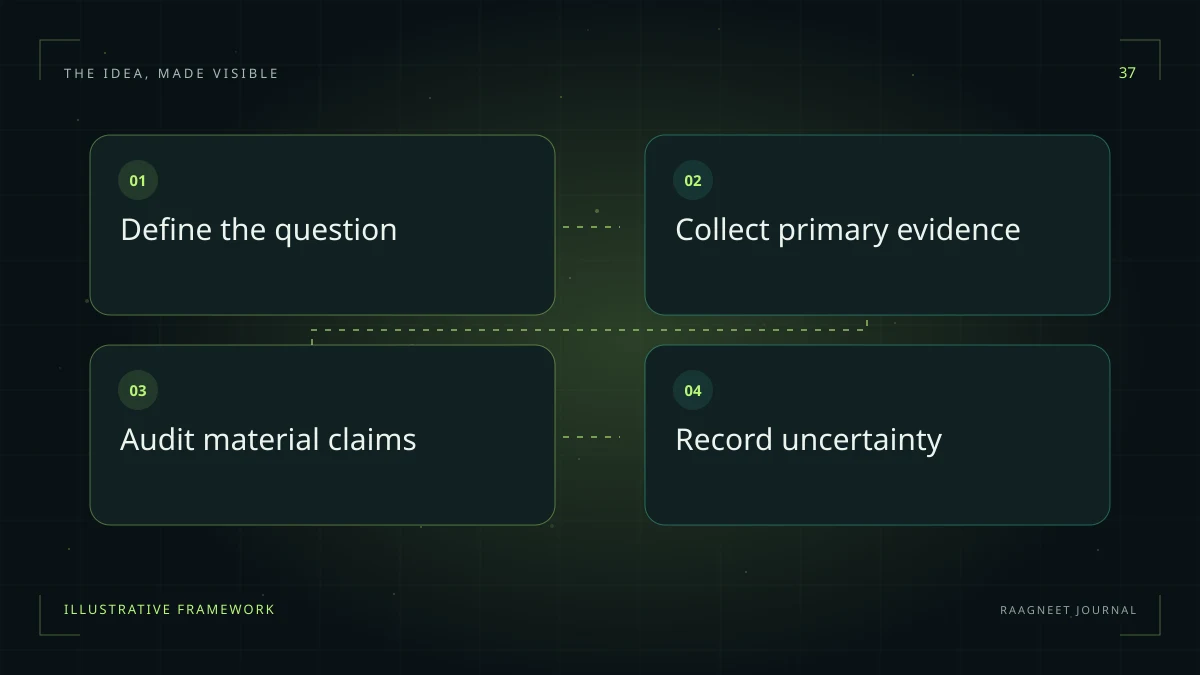
03Audit citations at the claim level
Choose the five most consequential sentences in each answer and inspect their references. Does the source support the exact number, date or availability condition? A link to a company homepage is not evidence for a specific API limit.
Record unsupported conclusions separately from missing citations. The model may cite a real page and still overstate what it says. Also check whether a secondary summary has displaced a more precise primary source that was available during the task.
04Test synthesis and uncertainty
Give the assistant a follow-up that changes an assumption. A useful research response should identify which conclusions must change and which evidence remains relevant. An answer that merely appends a caveat may leave the original recommendation internally inconsistent.
Ask for an evidence table containing claim, source, applicable date and uncertainty. This creates something a reviewer can audit. It also helps expose whether the model has confused its own inference with a fact explicitly reported by the source.
05Choose using review burden
Time the complete process: obtaining a useful draft, checking the references and repairing the important mistakes. Compare repeated questions across your actual subject areas. One impressive answer is a demonstration, not a dependable estimate of research quality.
Use the candidate that consistently meets your evidential threshold with manageable review. Keep an escalation path for specialist questions and ambiguous source conflicts. For published work, preserve the source list and review date so later readers can understand what the conclusion depended on.
Common questions
Which one has the most accurate citations?
This article does not establish a measured winner. Citation quality depends on the tools, sources and task. Use a fixed question set and audit the most important claims to determine which setup works better for your research.
Does a large context window guarantee better research?
No. More context allows more material to be supplied, but the assistant still needs to identify relevant passages, reconcile contradictions and avoid unsupported conclusions. Test those behaviors directly rather than using capacity as an accuracy score.
Sources & further reading
Primary documentation and further reading are linked below. Examples and decision frameworks are illustrative; product capabilities can change.
Researched against primary sources on 23 November 2026. Recommendations are editorial analysis, not a hands-on benchmark. Pricing and access can change. Original illustrations by RaagNeet. Send a correction.