GPT-6.2 is a model family, not a single universal setting. The first practical decision is which variant and product route you need. The second is how the model will interact with your existing prompts, tools and validation. This explainer focuses on those implementation choices so a release announcement can become an understandable evaluation plan rather than an assumption that every workflow improves automatically.
01What developers need to know first
OpenAI's integration guide says GPT-6.2 appends top-level instructions after input and explains how prefix edits can discard retained reasoning items. It recommends stable conversation prefixes. Those integration details matter independently of a model's benchmark performance. [1]
Audit how your application builds requests. If it repeatedly rewrites earlier messages or changes configuration midstream, inspect the effect on continuity and usage. Keep reusable instructions and conversation construction explicit rather than relying on an accidental arrangement of prompt text.
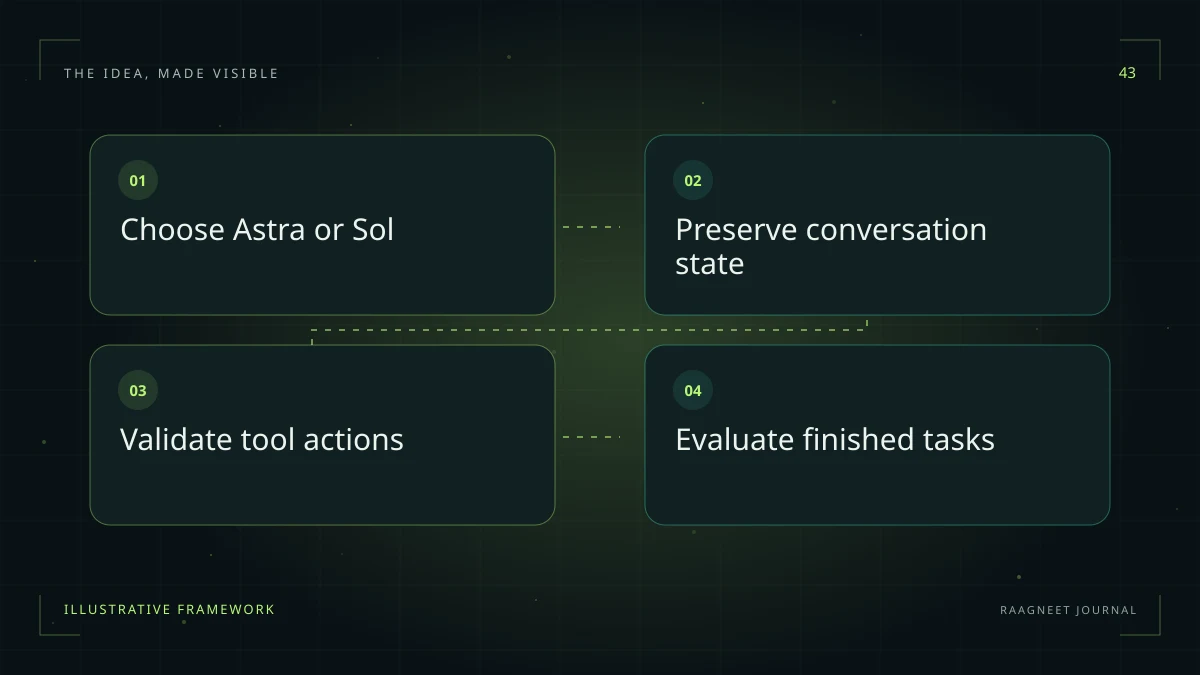
02Choose a variant against a workload
Separate routine tasks from work that requires deeper investigation. A short classification request and a multi-file engineering problem need different acceptance criteria. Start with the less expensive candidate that can meet the required outcome and escalate documented exceptions where useful.
Avoid treating the family name as a sufficient configuration record. Store the exact model, reasoning settings and tools for an evaluation. Without that information, a teammate cannot distinguish an actual model improvement from a changed prompt or a more capable execution environment.
03Build around tools and validation
A model can suggest an action, but the application should decide whether that action is allowed and correctly formed. Validate tool arguments, enforce permissions and make uncertain outcomes inspectable. This protects the workflow when model behavior changes.
For a customer-service assistant, separate retrieving an order from altering it. For a coding assistant, separate editing a file from publishing a release. Useful automation grows from clear boundaries that let the system complete ordinary work while pausing when prerequisites are missing.
04Understand what a demonstration proves
A polished sample can show that a task is possible under particular conditions. It does not establish reliability across your inputs. Prepare examples with conflicting instructions, absent data and unusual formatting to test where the workflow breaks.
Inspect the final output rather than judging only the conversation. Check code behavior, document structure or calculation results as appropriate. Require an accurate record of checks performed and keep unverified claims separate from observed completion.
05Plan an upgrade that can be reversed
Run a pilot with a versioned prompt and a held-out test set. Track accepted results, latency, usage and human corrections. Decide in advance which regressions would prevent rollout so the launch decision does not depend on a single impressive example.
Move traffic gradually and retain a fallback configuration. Document the reasons for selecting a variant and review them after real usage accumulates. GPT-6.2 is most useful when it fits a system whose performance you can observe and whose mistakes you can correct.
Common questions
Is GPT-6.2 one model?
The family includes Astra and Sol, with different positioning and rates. The exact model and product route matter for both evaluation and billing. Record the specific configuration rather than referring only to the family name.
Can I assume my current prompt is optimal?
No. First check compatibility and retained behavior, then test targeted changes. Preserve a baseline and compare outcomes. Changing the model and rewriting the prompt simultaneously makes it harder to understand why a result improved or regressed.
Sources & further reading
Primary documentation and further reading are linked below. Examples and decision frameworks are illustrative; product capabilities can change.
Researched against primary sources on 23 November 2026. Recommendations are editorial analysis, not a hands-on benchmark. Pricing and access can change. Original illustrations by RaagNeet. Send a correction.