For a coding team, the Neon-versus-Hydrogen question should start with the work waiting in the issue tracker. A quick implementation loop and a difficult investigation have different bottlenecks. This guide explains how to compare them without assuming that a newer name automatically means better code, or that a cheaper request necessarily produces a cheaper finished feature.
01Understand their intended roles
Google's announcements position Hydrogen around rapid execution and Neon around complex professional tasks. These descriptions help you choose test cases, but they cannot replace a repository-specific evaluation with the tools your team uses. [1]
Keep coding assistance separate from model access. A model selected inside an agentic development platform may have a terminal, browser and project instructions. A raw API call may have none of these. Document that difference before comparing output quality.
02Use a small but revealing task set
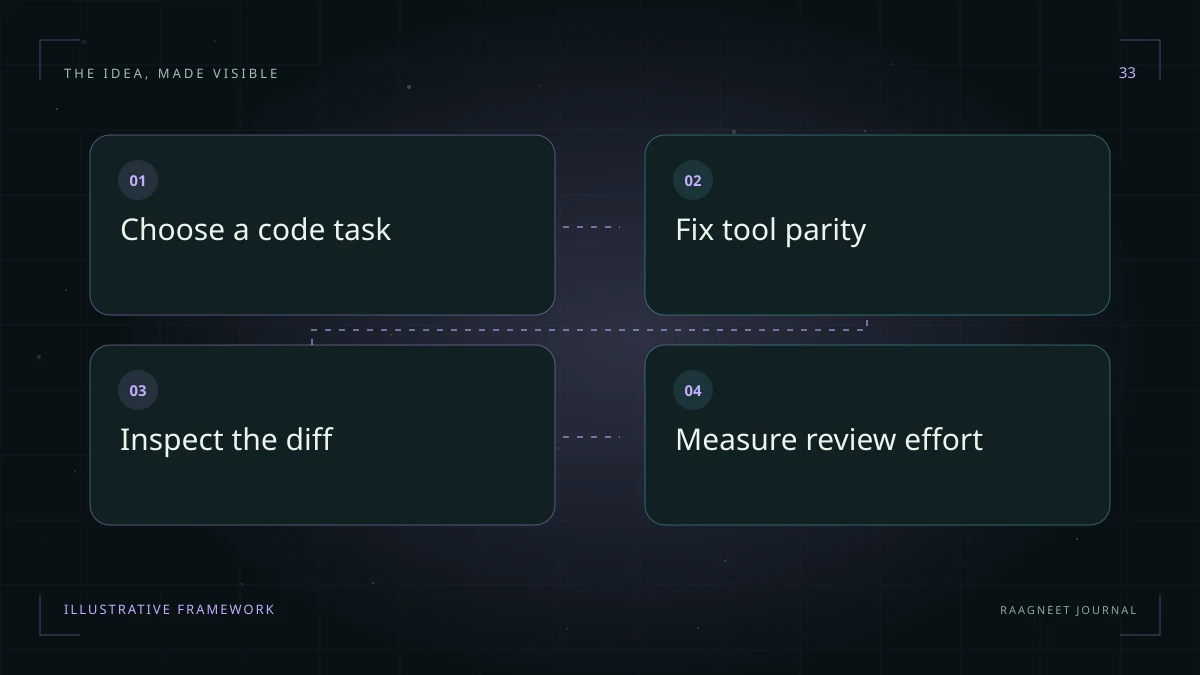
Select a validation bug, a cross-file change and a UI issue that only appears on a narrow screen. Add a task with incomplete requirements to see whether the assistant asks a useful question or silently makes a product decision.
Work from isolated checkouts with the same dependencies installed. Give both candidates the same initial brief and acceptance checks. Avoid polishing the prompt for one model while judging the other from its first attempt; that measures prompt preparation as much as model behavior.
03Look beyond a passing test
Review whether the fix addresses the underlying problem, preserves existing behavior and introduces unnecessary dependencies. Check that added tests would fail before the fix and cover a meaningful behavior instead of repeating the implementation.
For interface work, compare the actual rendered page at mobile and desktop widths. A clean screenshot can conceal broken navigation or keyboard interaction. Ask the assistant to explain what was verified and identify anything it could not observe.
04Control cost through task boundaries
Bound a task by its finish condition and allowed scope. A model repeatedly reading the entire project for a one-line change may consume more resources than necessary. Supply the reproduction and relevant constraints without prescribing an unverified solution.
Measure total usage through completion, including unsuccessful attempts. If a heavier investigation model reduces repeated repair loops, it may earn its place on complex bugs. If routine edits already pass with a lighter setup, keep them on that route.
05Choose a workflow rather than a slogan
For everyday implementation, trial Hydrogen on your common tasks and record where it needs intervention. Trial Neon on the same set plus difficult investigations. Decide whether the difference is material to your team's quality threshold.
You may prefer one model for the entire workflow to keep operations simple. Alternatively, route only documented exception categories to a second model. Either choice should have evidence from accepted changes and reviewer effort, rather than a general impression of eloquence.
Common questions
Is Neon automatically better because it is newer?
No. Release order does not establish task-specific performance. Compare completed work, tests and review burden using equivalent settings and tool access. Neither vendor positioning nor an unrelated benchmark substitutes for that check.
Can I use different models for implementation and review?
Yes, if your platform supports it. Give the reviewer the original requirements and the diff, then require concrete findings. A second model's approval is additional feedback, not independent proof that the code is correct.
Sources & further reading
Primary documentation and further reading are linked below. Examples and decision frameworks are illustrative; product capabilities can change.
Researched against primary sources on 23 November 2026. Recommendations are editorial analysis, not a hands-on benchmark. Pricing and access can change. Original illustrations by RaagNeet. Send a correction.