An upgrade is worthwhile when it improves the work your application performs without introducing unacceptable regressions. If Gemini 3.8 Flash already powers a working system, moving to Hydrogen is a migration project with prompts, tools and user expectations to protect. This guide focuses on the decision and rollout process rather than treating a model-name change as a complete implementation plan.
01Check the migration facts first
Hydrogen is a Gemini 4 model positioned for efficient agentic work. The release notes and pricing documentation are the places to verify the current model ID, availability and billing terms for your account and region. [1]
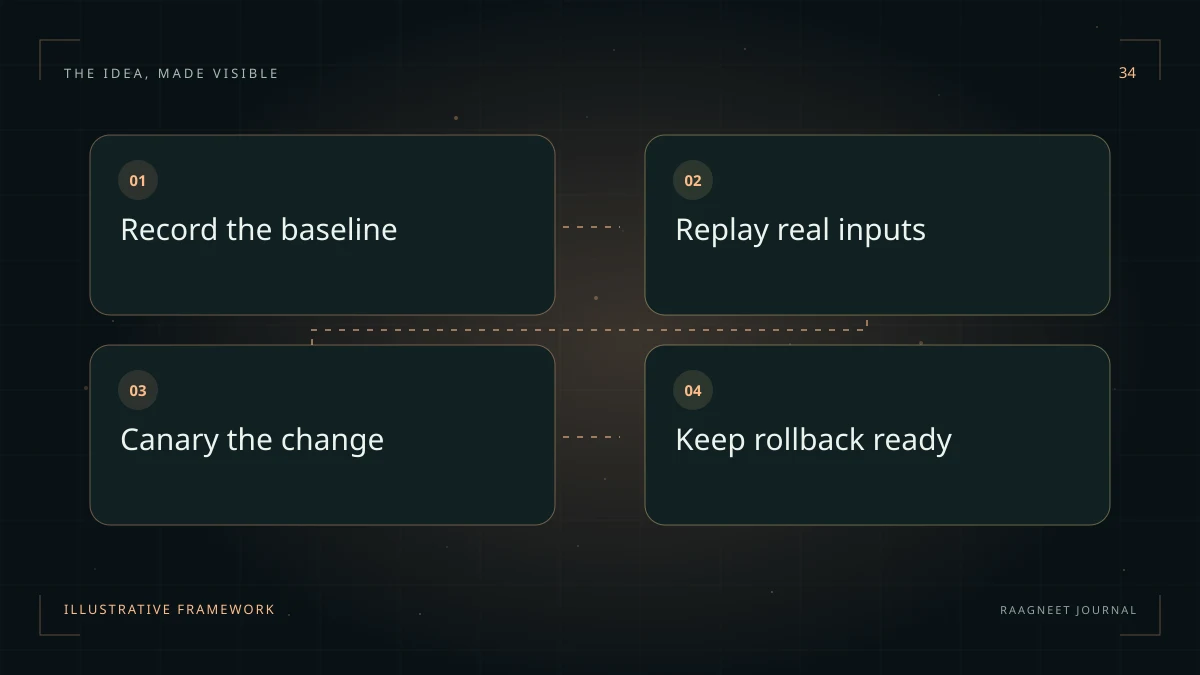
Do not assume an older alias stays mapped to the same model forever. Record the exact request configuration you use today, including generation settings, schemas and tool declarations. A reproducible baseline prevents confusion when an upstream default changes during your evaluation.
02Identify what you actually need to improve
List the recurring failures in the existing application: missing fields, weak code fixes, slow tool loops or incorrect treatment of conflicting instructions. Give each failure a severity and an example that another reviewer can understand.
If no important failure or cost problem exists, there may be no urgent business case for switching. Conversely, a measurable reduction in high-impact errors can justify a migration even when the new model's individual requests cost more.
03Replay representative requests
Create a held-out evaluation set containing successful cases and known failures. Keep private data appropriately controlled and use redacted examples where possible. Compare schema validity, task completion and unsupported claims rather than only whether a response looks polished.
Inspect changes to tool behavior explicitly. Does the model call the correct function, stop after a failed prerequisite and avoid duplicate writes? Your adapter should enforce permissions and validation so a changed model preference cannot silently bypass an operational boundary.
04Estimate the real upgrade bill
A migration estimate should include request usage, prompt revisions, evaluation development and developer review. Separate one-time integration work from recurring inference spend. Otherwise a seemingly economical upgrade can look disappointing simply because the budget categories were mixed together.
For interactive work, include response-time distribution and timeout behavior. Averages hide users who wait much longer than normal. For background work, throughput and recovery may matter more than a slightly slower response on an individual request.
05Release gradually and preserve an exit
Start with a noncritical workflow or a small percentage of eligible requests. Watch validation failures, user corrections and costs. Keep the old route available through configuration until you have sufficient evidence to retire it safely.
Promote the new model when it meets explicit acceptance criteria. If results regress, rollback should not require a code rewrite. Document prompt changes and evaluation findings so a later migration starts with a useful history instead of another unstructured experiment.
Common questions
Can I upgrade by changing only the model string?
Sometimes the API accepts that change, but request compatibility is only the first check. Structured outputs, tools, response style and failure behavior still need evaluation before production traffic is moved.
Should I delete my Flash prompts after migration?
Keep a versioned record of prompts and settings associated with each release. That record supports rollback, regression investigation and future comparisons. Remove unused operational paths only after the new setup has demonstrated stable behavior.
Sources & further reading
Primary documentation and further reading are linked below. Examples and decision frameworks are illustrative; product capabilities can change.
Researched against primary sources on 23 November 2026. Recommendations are editorial analysis, not a hands-on benchmark. Pricing and access can change. Original illustrations by RaagNeet. Send a correction.