Carbon is interesting when a task needs sustained investigation rather than a quick answer. The practical question is whether that additional effort produces a better finished result for your team. This explainer separates Google's positioning from a proposed evaluation method and highlights the operational decisions that matter before assigning a long-running engineering or analytical workflow to a frontier model.
01Understand the claimed distinction
Google's Carbon announcement emphasises deep investigations and sustained agentic work. These are provider claims and evaluation context, not measurements from a RaagNeet deployment. The availability post explains the rollout and which public and specialist routes apply. [1]
Use that positioning to select appropriate test tasks. A difficult cross-module failure may reveal a useful difference that a routine formatting request does not. Conversely, an ambitious model is not automatically economical for requests that already have a reliable simple solution.
02Choose a task that rewards investigation
Prepare a reproducible bug with several plausible causes and enough evidence to rule them out. Require a final explanation connecting the fix to the observed failure. Avoid judging only whether the model finds a way to make one narrow test pass.
Preserve the starting commit and relevant logs so the work can be reviewed. If the task includes external systems, use a controlled environment with the required permissions. A model's willingness to continue is useful only when the investigation remains bounded and observable.
03Set budgets and stopping rules
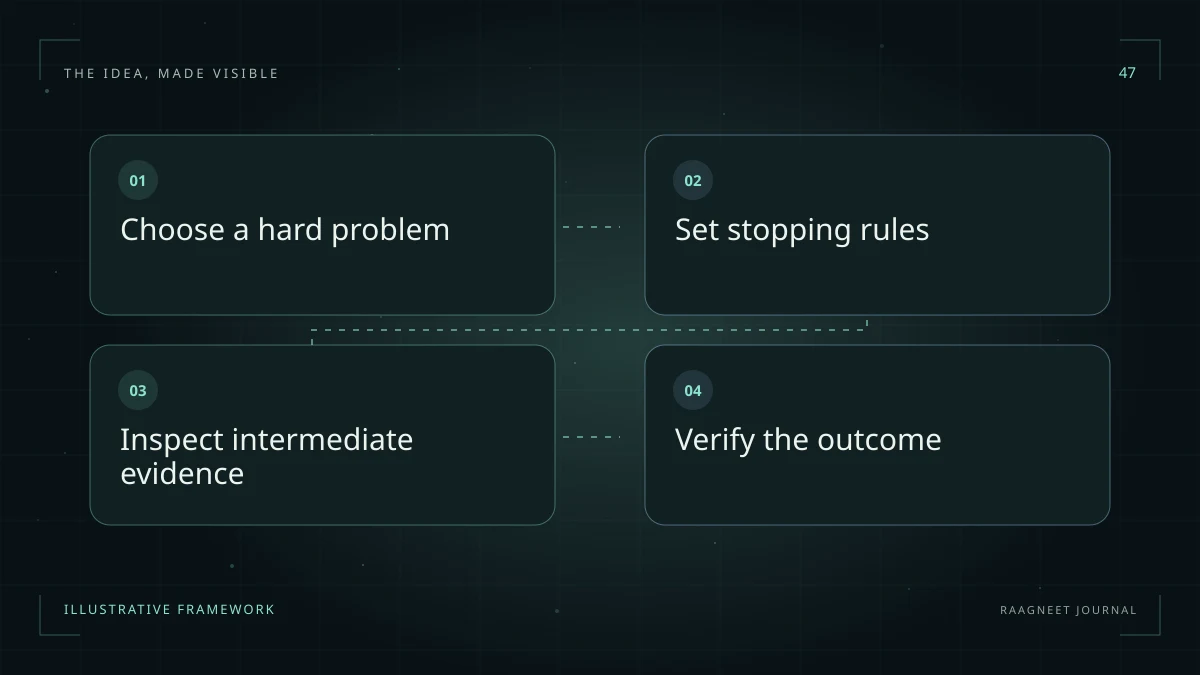
Define when the task should stop: a verified outcome, a missing prerequisite, a spending limit or an unresolved ambiguity that requires a person. This prevents persistence from turning into repeated work without measurable progress.
Use checkpoints for long runs. Record hypotheses tested, changes made and outstanding uncertainty in a concise format. These artifacts make handover easier and help a reviewer distinguish a useful investigation from a sequence of increasingly elaborate guesses.
04Review pricing and access carefully
Google's availability documentation states that introductory Carbon pricing expires on November 30, 2026, with a higher public rate afterwards. Check the exact live API pricing and account route before using a launch-period estimate for a long-term budget.
Model the total task rather than one request. Extended investigations can involve repeated context, tools and verification loops. Compare the complete resource usage with the time and quality benefit, including the work a reviewer still has to perform.
05Decide whether extra effort is justified
Compare Carbon with a baseline on the same difficult tasks and tools. Record accepted results, important mistakes and correction effort. If the difference appears only on a narrow category, route that category selectively instead of changing the default for everything.
Keep your conclusion modest and reproducible. A documented improvement on complex debugging does not establish a winner for every kind of research or business analysis. The model earns its place when the observed benefit matches a recurring need in your workflow.
Common questions
Does long-horizon capability mean unsupervised production access?
No. Duration and autonomy are separate decisions. Define tool permissions, spending limits and review points around the actual task. Require explicit handling of blockers and uncertain writes even when the assistant can continue working for a long time.
Is the introductory rate permanent?
No. The linked availability post specifies an expiry for the introductory public rate. Check current pricing and include the post-promotion period in your forecast. Also verify whether your chosen access route has different billing terms.
Sources & further reading
Primary documentation and further reading are linked below. Examples and decision frameworks are illustrative; product capabilities can change.
Researched against primary sources on 23 November 2026. Recommendations are editorial analysis, not a hands-on benchmark. Pricing and access can change. Original illustrations by RaagNeet. Send a correction.