The cheapest AI model is the least expensive one that completes your application's task reliably enough. A low advertised input price can be overwhelmed by long outputs, repeated attempts, external tools and human review. Before choosing an API, define the output your application needs and measure how much work is actually required to produce it under ordinary and difficult conditions.
01Begin with an auditable price snapshot
At review time, OpenAI lists Sol at $2 input/$10 output and Luna at $0.10/$0.50 per million tokens. Google's Hydrogen announcement lists $1.50/$7.50. These are standard token-rate examples, not equivalent quality or total-service comparisons. [1]
Rates depend on the model, processing tier and applicable terms. Check the linked official pages immediately before purchase. Keep a dated copy of your assumptions in the budget so a later price change is distinguishable from an increase in application usage.
02Calculate a realistic request
Use the formula input tokens times input rate plus output tokens times output rate, dividing each by one million. For 8,000 input and 1,000 output tokens, Hydrogen's quoted rates produce an illustrative token cost of $0.0195 before extras.
Do not use that example as your application's forecast without measuring requests. A document assistant may send much larger inputs, while a code agent may invoke the model repeatedly. Capture usage across the whole operation, not just the last visible message.
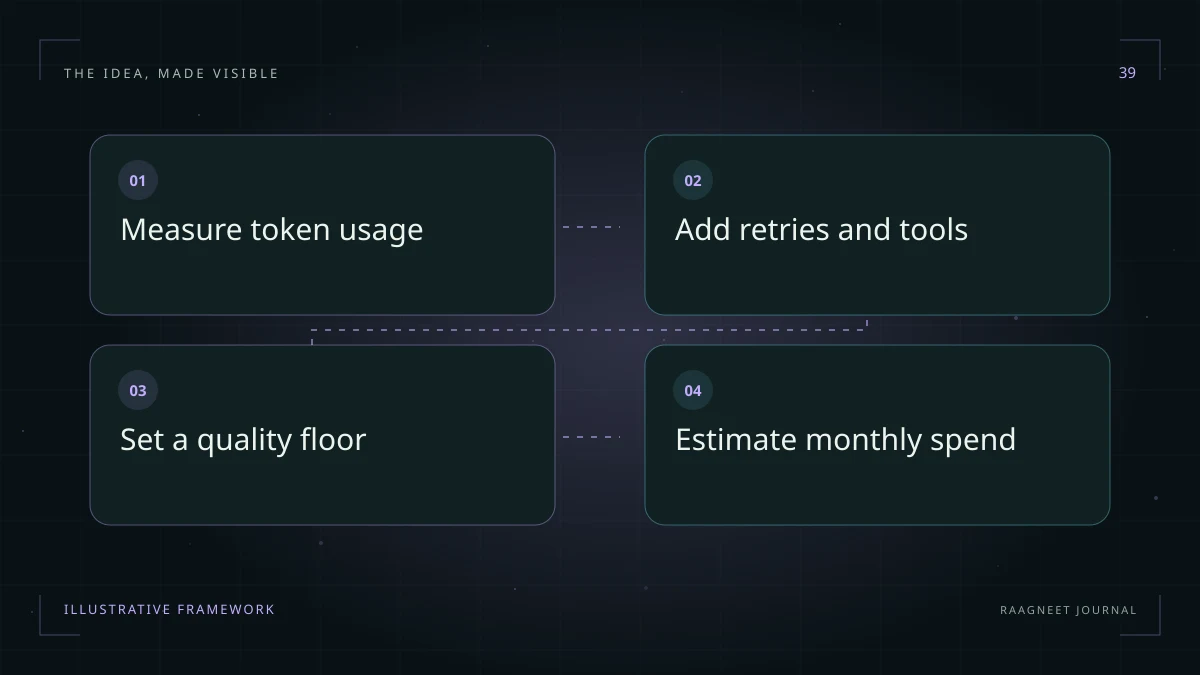
03Price successful work rather than calls
Suppose two setups handle the same extraction job. One returns valid structured data on the first attempt; the other needs repeated correction. Compare the total billed usage and review required per accepted record, not the nominal cost of the initial request.
Also include what happens when tools fail. Search charges, execution environments and integrations may be billed separately. Add monitoring and engineering support to the operational budget, especially if a cheap model needs substantial application logic to meet your reliability threshold.
04Use caching and routing carefully
Repeated context can create an opportunity for caching where supported. Measure the actual hit rate and confirm the provider's rules before assuming a discount. A frequently changing prompt prefix or a workload of unrelated requests may deliver less reuse than expected.
Route simple requests to a lower-cost candidate only after it passes the same validation. Escalate exceptions with their evidence intact. The routing layer itself should stay understandable; an elaborate classifier can cost more to operate than it saves on a small application.
05Build a budget that survives growth
Estimate a baseline month and a peak month using completed operations, average usage and a realistic retry allowance. Separate development experiments from production demand. Add spending alerts and an application-level limit where your business needs a predictable ceiling.
Review the estimate after a pilot using real usage records. If a model is cheap but misses critical cases, improve the workflow or choose another model. The cost target is meaningful only after you have established the minimum acceptable outcome for customers.
Common questions
Is a free API the cheapest production option?
It may be useful for experiments, but quotas, availability and data terms can make it unsuitable for a commercial workload. Model hosting, review and integration still have costs. Evaluate the whole service rather than only the token bill.
Does the lowest output price guarantee the lowest bill?
No. Input size, reasoning usage, response length, retries and tools all matter. Compare measured end-to-end usage for the same successful task, then use the applicable current rates to calculate the actual operating cost.
Sources & further reading
Primary documentation and further reading are linked below. Examples and decision frameworks are illustrative; product capabilities can change.
- OpenAI: model catalogue
- Google: Gemini API pricing
- Microsoft: MAI Code 2 and Flash announcement
- Google: Gemini 4 Hydrogen announcement
Researched against primary sources on 23 November 2026. Recommendations are editorial analysis, not a hands-on benchmark. Pricing and access can change. Original illustrations by RaagNeet. Send a correction.