Free AI can mean a consumer chat account, a limited API allowance, a trial inside a coding tool or a model you run on your own hardware. These options solve different problems. The best free setup is the one whose restrictions fit your task, not the one advertised with the largest model name. This guide helps you distinguish useful access from a production plan that depends on resources you cannot reliably obtain.
01Start with the access category
Google's API pricing page distinguishes free and paid access, including differences in model availability and data handling. That makes it a useful place to check a prototype's assumptions. Other applications and subscriptions have their own terms and quotas. [1]
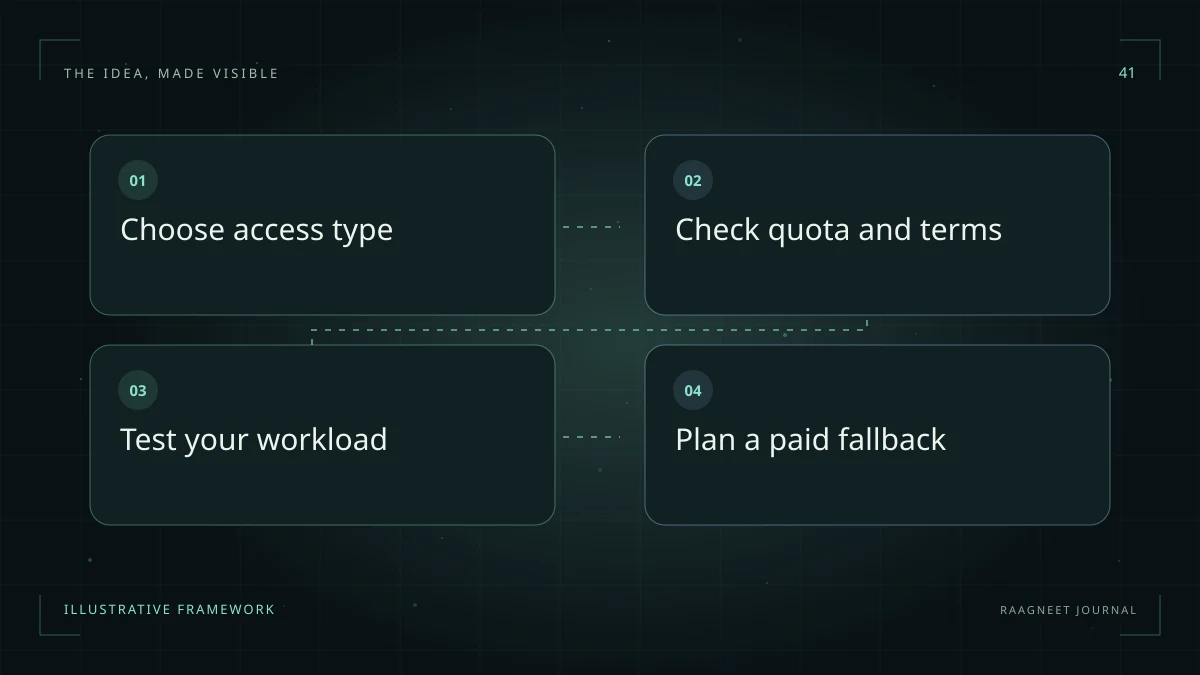
Write down whether you need a person to chat, a developer to edit code or a server to make automated requests. A free product in one category may not provide the integration required in another. This distinction prevents a common and expensive planning mistake.
02For learning, prioritise feedback quality
A free assistant can help explain unfamiliar code, explore a concept or draft a small experiment. Choose tasks you can verify through documentation or a local example. Ask for assumptions and try a counterexample rather than treating a fluent explanation as proof.
Keep an independent learning path. If a quota is exhausted, you should still be able to read the official guide and run the example yourself. The most useful free tool improves your understanding rather than becoming a dependency for every small decision.
03For prototypes, test the quota shape
Record limits that affect your actual usage pattern: burst traffic, repeated tool loops or long documents. A daily allowance may appear generous until several requests arrive together. Design a visible error state instead of leaving users waiting indefinitely when access is unavailable.
A prototype should also have a clear route to production. Confirm how billing would be enabled, what changes in the data terms and whether the same model remains available. Keep secrets out of frontend code even when the initial API usage is free.
04For local models, price the machine
Running a model locally changes the cost structure. You still need enough memory, storage and compute for the workload, plus time to install and maintain the runtime. Check the model licence before assuming that local availability permits your intended commercial use.
Measure usable output on your own hardware. A model that fits into memory but responds too slowly may not suit an interactive feature. Include electricity, operational ownership and the cost of a fallback when comparing local inference with a hosted service.
05Choose a free tier with an exit plan
For occasional personal use, limits may be acceptable. For a public application, plan how to handle unavailable capacity and when to move to paid access. Set an explicit threshold based on actual usage and the importance of the workflow.
Keep a small evaluation set so you can compare alternatives without rewriting the whole application. Review terms when the product changes. Free access is a useful starting resource, but its value depends on what you can complete reliably and what happens when the allowance runs out.
Common questions
Which free model is unlimited?
Do not assume unlimited access without explicit current terms. Hosted services may apply quotas or fair-use rules, and local models are limited by your hardware. Identify the limit relevant to your workload before making a recommendation.
Can a business use free AI safely?
It depends on the service, data and workflow. Review data handling, commercial terms and access controls. Start with non-sensitive examples and verify important outputs; a zero subscription price does not remove operational responsibility.
Sources & further reading
Primary documentation and further reading are linked below. Examples and decision frameworks are illustrative; product capabilities can change.
Researched against primary sources on 23 November 2026. Recommendations are editorial analysis, not a hands-on benchmark. Pricing and access can change. Original illustrations by RaagNeet. Send a correction.