A coding assistant is more than the model selected in its interface. Codex, Claude Code and Google Antigravity provide environments for working with projects, tools and verification. The best choice depends on how your team develops software and which parts of that process need help. This comparison offers a buying framework rather than a fabricated hands-on ranking or a promise that one tool wins every task.
01Understand the product layer
The linked official product documentation describes each environment's approach and supported workflows. Capabilities and plan access can change, so confirm the features available to your account rather than assuming a screenshot from another user's setup applies to yours. [1]
Record the interface, selected model, tools and approval settings in your comparison. An environment that can inspect a running browser has different evidence available from one limited to editing files. A fair review makes those differences explicit instead of attributing everything to intelligence.
02Check fit with your daily work
Consider whether developers spend most of their time in a terminal, an editor or a project workspace. Evaluate setup effort, repository switching and how the assistant receives local instructions. The best tool is one the team can use consistently without fighting its normal workflow.
Also check how work is reviewed and handed over. A readable diff and concise verification record may matter more than a polished conversation. Team adoption should include people maintaining the generated code, not just those enjoying the initial implementation experience.
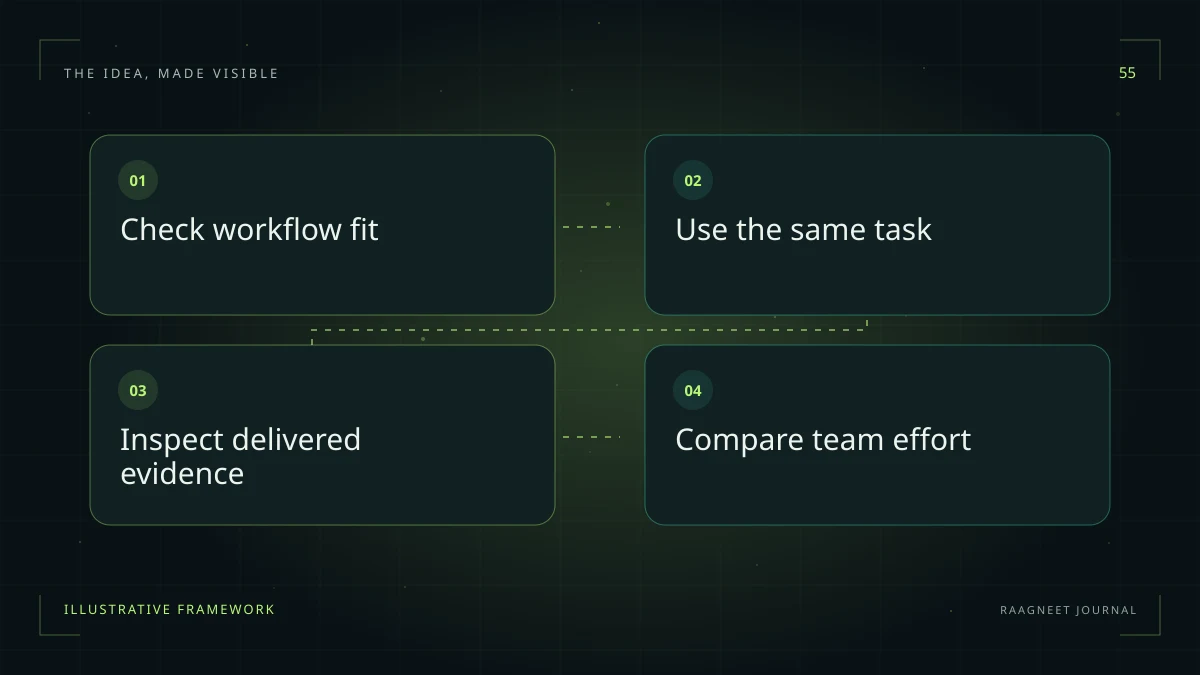
03Run an equivalent engineering task
Choose a bug with a reliable reproduction and a feature with explicit constraints. Give each environment the same starting commit and brief. Supply the same permissions where practical, and document any tool capability that cannot be matched.
Inspect the final behavior in addition to the patch. For interface work, use mobile and desktop viewports; for backend work, test the affected contract and failure state. Require an accurate account of what was checked and what remains blocked.
04Evaluate control and recovery
Review how each setup handles tool permissions, missing prerequisites and unexpected failures. A useful assistant should preserve the task's scope and identify when a person must supply information. It should not convert an uncertain external action into repeated blind retries.
Try a correction after the first attempt and see whether the tool incorporates it without undoing useful work. This collaborative behavior affects daily productivity. Record the human time needed to guide, inspect and repair the result rather than timing only the initial response.
05Choose a default with a review date
Compare accepted outcomes, reviewer effort, total usage and operational fit. Separate routine edits from complex investigations if the results differ. Current subscriptions and quotas should be checked directly before purchase; API pricing alone does not describe a seat-based development product.
Adopt a default when the evidence supports it and keep a small alternative path where useful. Set a review date so new releases can be evaluated without restarting the whole decision. A durable comparison process is more valuable than a permanent winner attached to a rapidly changing product category.
Common questions
Which assistant is the overall winner?
This guide does not establish a universal measured winner. Choose with a pilot covering your repository, tools and review standards. A tool that suits one team's development environment may impose extra work on another.
Can I compare them using the same underlying model?
Where supported, that can help isolate environment differences. Otherwise document the selected models and settings. In either case, judge the complete delivered result and the effort needed to review and maintain it.
Sources & further reading
Primary documentation and further reading are linked below. Examples and decision frameworks are illustrative; product capabilities can change.
Researched against primary sources on 23 November 2026. Recommendations are editorial analysis, not a hands-on benchmark. Pricing and access can change. Original illustrations by RaagNeet. Send a correction.