A useful automation does more than pass text between apps. It receives an event, understands what matters, makes the appropriate decision, and leaves a result someone can trust. AI can help with variable language inside that process, while ordinary code should still handle identities, deadlines, permissions, and the consequences of a retry.
01Decide which step actually needs AI
A fixed workflow follows known paths; an agent dynamically selects its steps. Many business automations only need AI for a narrow transformation, such as extracting a service request from an email. The remaining steps can stay predictable and directly testable. [1]
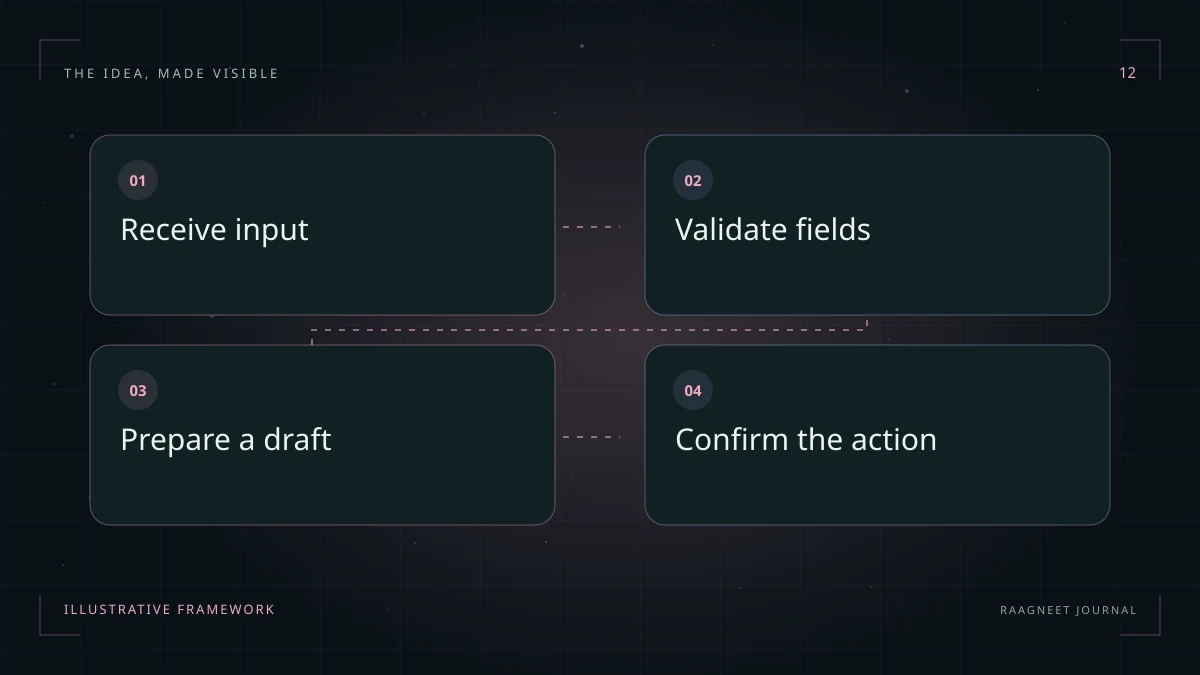
Consider a project enquiry form. Required fields, email validation, and acknowledgement status do not require a language model. Summarising a free-text brief may benefit from one. Keeping that distinction makes the workflow easier to explain and gives the team fewer uncertain operations to maintain.
02Convert text into a typed contract
Structured output features let compatible models produce data matching a supported JSON schema. They reduce the work of parsing free-form text, but schema compliance does not establish that the values are factually correct. Validate both shape and meaning before using the result. [2]
For a proposed enquiry workflow, the model could return service, timeline, summary, and missing_questions. Unknown values should remain unknown. Check permitted service names and whether a deadline is a valid date. Do not let a polished summary silently replace the original request.
03Make events safe to retry
Assign each source event a stable identifier. Store the workflow state and check whether a downstream operation already completed. A webhook sender may retry after a timeout even when your application processed the first request successfully.
Separate transient failures from permanent validation problems. A temporary network outage may justify a delayed retry; an invalid customer identifier needs correction. Cap retry attempts and provide a dead-letter or review queue so failed work remains visible instead of disappearing into logs.
04Put review at the consequential boundary
An internal draft can often be generated with low friction. Sending a proposal, changing a contract, or publishing a message has a different impact. Make the final action and its recipients visible to the authorised person before execution where the workflow requires approval.
A review screen should include the original request, extracted fields, missing information, and the exact proposed effect. It should let someone edit or reject the draft without restarting the entire workflow. Those controls make the automation useful in imperfect real-world cases.
05Measure completed work and exceptions
Track whether the intended result happened once, whether the extracted information was correct, and how much review time the process required. Also track unsupported requests, overdue approvals, failures, and duplicate events. A high processing count can conceal a growing queue of unresolved exceptions.
Start with one workflow and a clear owner. Write down how to pause it, replay a failed event safely, and handle provider outages. Automation earns trust by being predictable when it fails as well as efficient when it works. Extend the system after the team can operate its first version confidently.
Common questions
Should every workflow use an autonomous agent?
No. A fixed workflow with one AI extraction or drafting step is often sufficient. Use dynamic planning only when the task needs it and you can evaluate the resulting actions.
What is idempotency in an automation?
It means repeating the same intended operation does not create additional unintended effects. A stable event ID and stored operation state can help prevent duplicate messages or records.
Sources & further reading
Primary documentation and further reading are linked below. Examples and decision frameworks are illustrative; product capabilities can change.
Created with AI assistance for the RaagNeet Journal. This guide does not claim original product testing or benchmark results. Original illustrations by RaagNeet. Send a correction.