An AI agent becomes useful when it can help complete a specific business task with clear limits. For a small team, the starting point is often sorting enquiries, preparing a draft response, or checking whether a project brief is complete. The useful question is how reliably the system completes that task, and how easily someone can correct it.
01What makes an agent different from a chatbot?
A chatbot mainly produces a response. An agent can select tools, inspect results, and decide what to do next. A workflow can also use AI while following a predetermined sequence. This distinction matters: if your process already has predictable steps, ordinary automation with one AI step can be easier to understand and maintain. [1]
Imagine an enquiry assistant that extracts a deadline and a budget. It can create a draft brief without deciding which client deserves priority. That is a useful initial boundary. Add independent decisions only when you can describe their expected outcome and recognise a wrong one.
02Choose a workflow with a clear finish line
Tools need descriptions that make their inputs, outputs, and consequences understandable. A broad tool called manage_customer is harder to constrain than separate tools for finding an account and preparing a draft update. Narrow operations also make failures easier to investigate. [2]
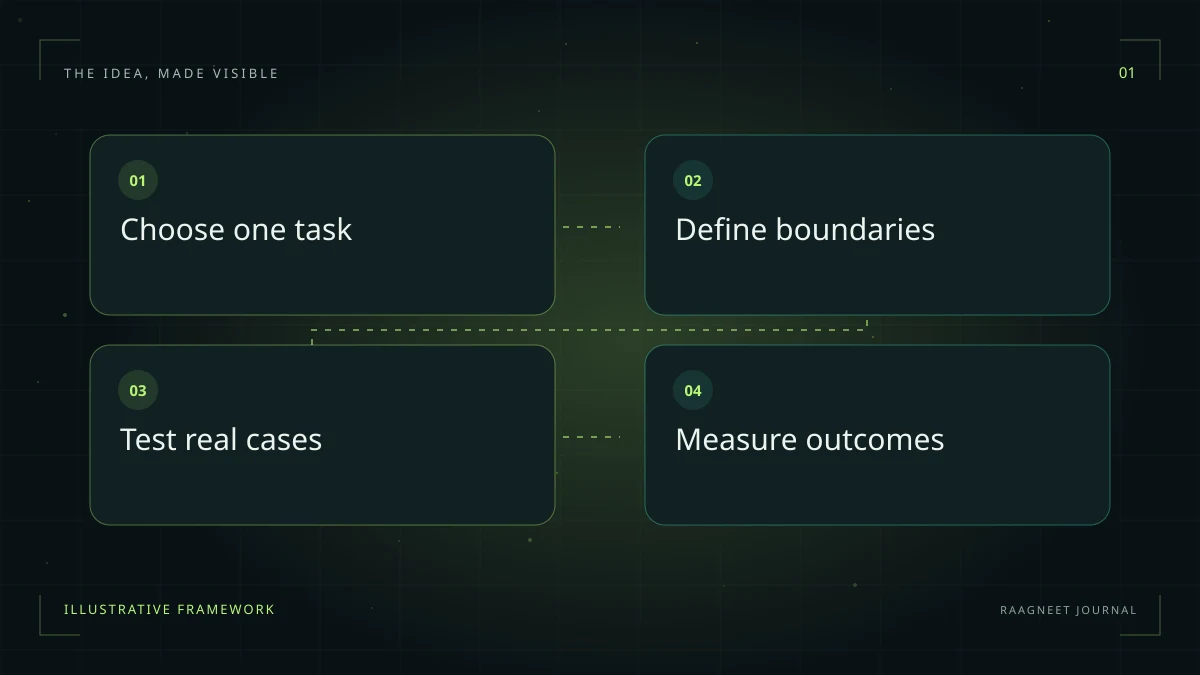
For an illustrative pilot, choose incoming website enquiries. Define success as a draft brief containing the requested service, timeline, contact details, and missing questions. The agent should stop when those fields are ready, when a required source is unavailable, or when the message is outside its supported scope.
03Put permissions into the system design
Separate information gathering from actions that affect people. Reading a public service page and drafting an internal note need different permissions from sending a proposal or modifying an invoice. Enforce that difference in application code and tool credentials, rather than relying on the model to remember a sentence in its prompt.
Give every run a record identifier and preserve a concise action log. If a tool times out, the system should know whether an operation happened before trying again. An uncertain write should lead to a status check or a human review, because a retry can otherwise create duplicate work.
04Run a useful pilot
Build a small collection of realistic enquiries: clear briefs, vague messages, spam, conflicting deadlines, and requests for unsupported services. Compare the drafts with the work a team member would normally prepare. Record missing facts, invented claims, processing time, and the effort needed to review each result.
These examples are a proposed evaluation process, not results from a RaagNeet deployment. A pilot earns expansion when it handles your actual variation well. A polished demonstration with one easy example does not establish production reliability.
05Know when to keep the workflow simple
Track completed useful tasks rather than the number of messages generated. Include model usage, integrations, monitoring, review time, and recovery from failures in the cost. A cheaper model can become the more expensive system when it creates longer reviews.
Keep the first version small enough that someone on the team can explain every action. Expand to a second workflow only after the first has an owner, a measurable benefit, a way to pause it, and a reliable route to a person when the answer is uncertain.
Common questions
Does every small business need an AI agent?
No. A form, a rule-based automation, or a better help page may solve the problem with less maintenance. Choose an agent when variable inputs require useful judgment between well-defined tools.
Can an agent send customer replies automatically?
It can be built to do so, but begin with reviewed drafts. Expand permissions only after testing realistic failure cases and deciding which situations must always reach a person.
Sources & further reading
Primary documentation and further reading are linked below. Examples and decision frameworks are illustrative; product capabilities can change.
Created with AI assistance for the RaagNeet Journal. This guide does not claim original product testing or benchmark results. Original illustrations by RaagNeet. Send a correction.