Free-form text is a useful interface for people and a fragile contract between systems. If an application needs a service category, a date, and a short summary, parsing them from a paragraph adds unnecessary uncertainty. Structured output features can produce a predictable shape, while your application remains responsible for checking what those fields actually mean.
01Define the contract before the prompt
Compatible AI APIs can constrain generated output using a supported subset of JSON Schema. This makes the expected structure explicit: objects, arrays, strings, numeric values, and permitted options can be described in the request. Provider support and syntax vary, so check the current API documentation. [1]
For an illustrative project brief, define service as an allowed category, deadline as a nullable string with a documented format, and questions as an array of strings. Explain each field in plain language so the model has less room to interpret its purpose inconsistently.
02Distinguish structure from truth
Local inference tools can also support schema-constrained output with compatible models. The same limitation applies across local and hosted systems: a valid object can contain a wrong name, an invented date, or an inappropriate category. Syntactic reliability and semantic reliability are different concerns. [2]
Keep the original source alongside extracted data. A reviewer should be able to see whether a budget was supplied or inferred. If the source says next spring without a clear year, the correct output may be an unresolved deadline plus a question, rather than a precise invented date.
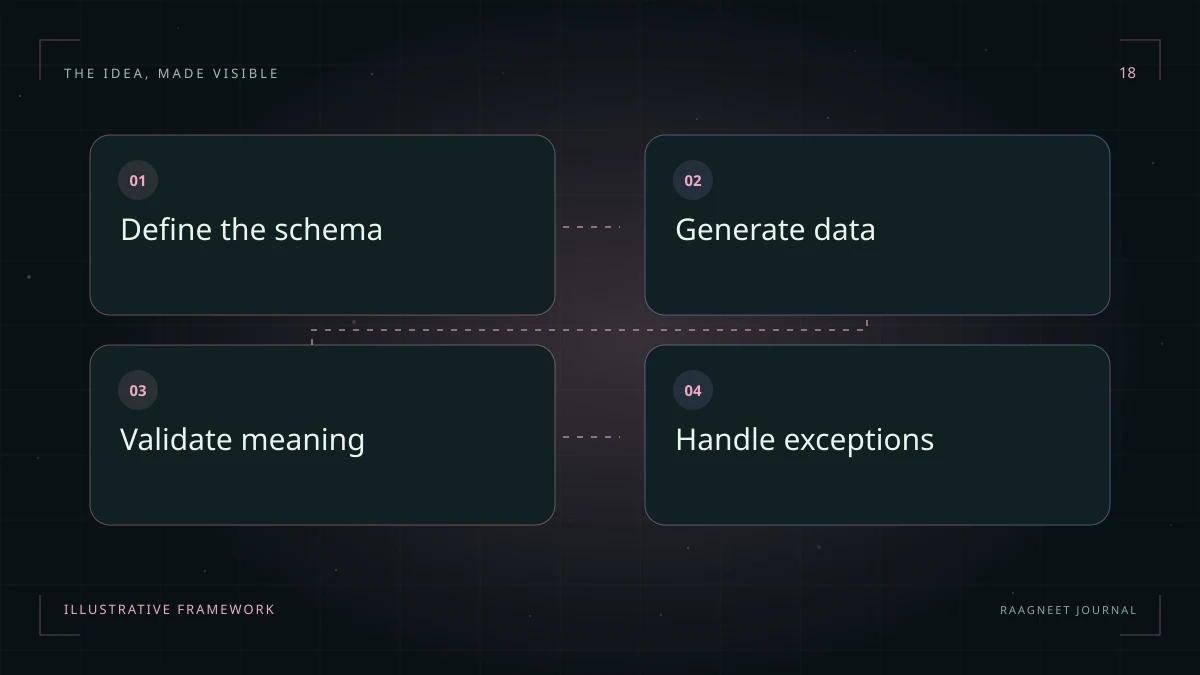
03Design missing values deliberately
Decide whether absence is represented by null, an empty array, a specific status, or a validation failure. Keep that convention consistent. A required property does not need to imply that the underlying real-world fact is known; it can explicitly contain an unknown value where the schema permits it.
Avoid using ambiguous sentinel strings such as N/A for every missing field. Differentiate unsupported requests from missing evidence and from a processing failure. These distinctions let the application route the case appropriately without relying on another model to interpret the result.
04Validate the next action separately
After parsing, check business rules: permitted date ranges, valid record identifiers, supported currencies, and the user's authority to affect the selected account. A schema can describe a string identifier without proving that the record exists or belongs to the user.
Do not execute arbitrary tool names or destinations from generated data. Translate an allowed enum into a known application operation, then validate its arguments. Keep approval requirements around consequential actions even when their proposed arguments came from a schema-constrained response.
05Build a useful failure path
Handle refusals, truncated output, timeouts, and schema rejections explicitly. Set bounded retries and record the reason for a retry. If a corrected request still fails, show a clear error or route to a person instead of silently accepting partial data.
Evaluate on malformed inputs, contradictory statements, unsupported requests, and absent fields. Compare complete task success, not only parse success. Structured output is valuable because it makes the boundary between generated language and application logic easier to inspect, not because it makes that boundary disappear.
Common questions
Does valid JSON mean the AI answer is correct?
No. It means the output can be parsed and may match a schema. Facts, record ownership, and business rules still need independent validation.
Should I use structured output or tool calling?
Use structured output when the application needs a response in a defined shape. Use tool calling when the model is requesting a supported operation. Validate both before further action.
Sources & further reading
Primary documentation and further reading are linked below. Examples and decision frameworks are illustrative; product capabilities can change.
Created with AI assistance for the RaagNeet Journal. This guide does not claim original product testing or benchmark results. Original illustrations by RaagNeet. Send a correction.