Adding an AI feature introduces a new path for website data. A visitor's message may pass through a model provider, application logs, an analytics system, and a support queue. Before launch, map that path and decide which information each component actually needs. This guide covers engineering considerations; applicable legal obligations depend on your jurisdiction and use case.
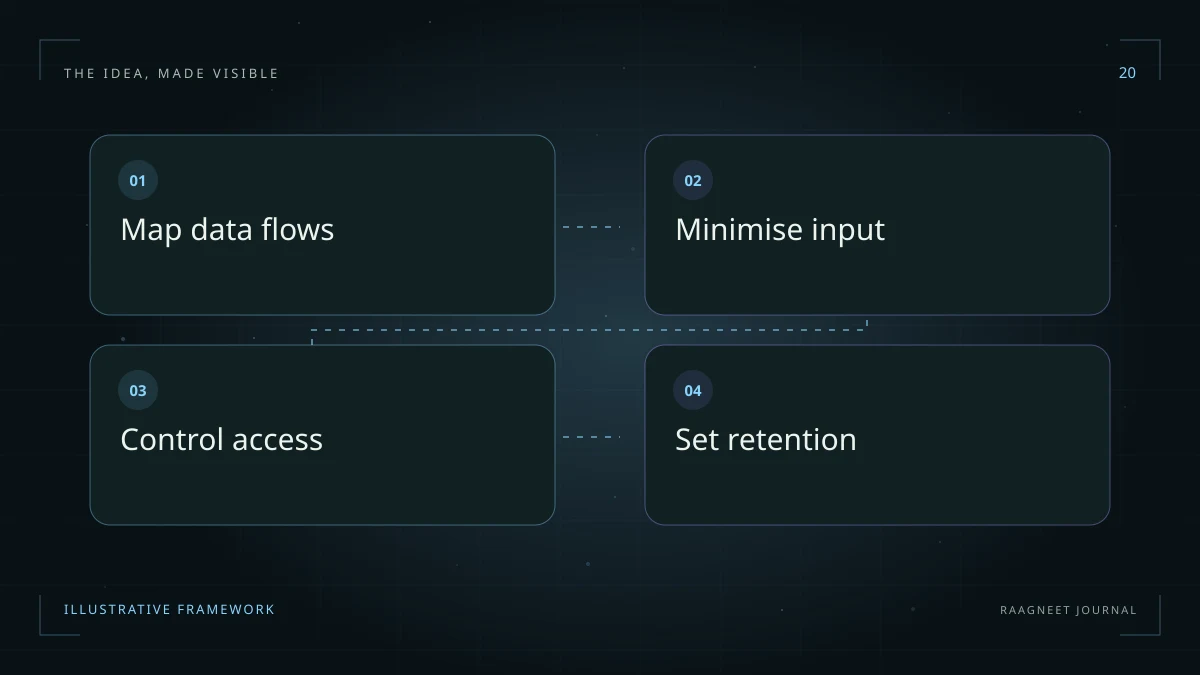
01Start with purpose and data minimisation
The UK Information Commissioner's Office describes data minimisation as using no more personal data than is necessary for a defined purpose. Its AI guidance is a useful reference for thinking through collection and retention, though it is not a substitute for advice about the laws that apply to your business. [1]
For an illustrative enquiry assistant, summarising a project brief may require the service request and timeline. It usually does not require unrelated browsing history or a full account export. Ask why every field is present and remove information that contributes no useful function.
02Enforce access before generating an answer
Permissions-aware retrieval restricts source access using a verified identity. This is stronger than giving all retrieved information to a model and asking it not to reveal certain records. Apply the same account boundaries to embeddings, document chunks, and source metadata. [2]
A customer support feature should not search another customer's project notes because the wording is semantically similar. Test that boundary with separate fixture accounts. Inspect both the retrieved passages and the visible response, because a leak can occur before the final answer is displayed.
03Review every data destination
List the model provider, storage services, observability tools, plugins, analytics, backups, and human support systems. Check current contractual terms, retention settings, training-use policies, regional processing options, and deletion capabilities for the exact service tier you use.
Avoid making blanket claims such as your data never leaves this website unless the architecture supports them. A browser interface can look local while sending content to a remote API. Explain the actual behaviour clearly and keep that explanation aligned with production configuration.
04Set retention and redaction rules
Decide which logs are necessary for debugging and how long they remain useful. Remove credentials and unnecessary personal information from prompts, traces, errors, and analytics events. A detailed trace is convenient during development and can become an avoidable exposure in production.
Keep deletion requirements in mind across primary records, document indexes, derived embeddings, and backups. Deleting a visible conversation does not automatically remove every copy or derivative. Document the system's actual capabilities and route unresolved requests to the responsible person.
05Test the privacy boundary as a feature
Use non-sensitive fixtures to test account separation, accidental inclusion of extra fields, tool permissions, and log redaction. Check the failure path too: an error message should not expose a raw request containing private content. Give the team a way to pause a problematic integration.
Review the map whenever a provider, model feature, plugin, or logging tool changes. Privacy is easier to maintain when the architecture has narrow data contracts and clear ownership. Make the website's promises precise enough that an engineer can verify them and a visitor can understand them.
Common questions
Does choosing local AI solve every privacy issue?
No. The interface, logs, plugins, backups, and cloud fallbacks can still process data elsewhere. Verify the complete flow before making a privacy claim.
Can I give the model all records and tell it not to reveal private ones?
That is a weak boundary. Restrict access before retrieval and tool execution using verified identity and server-side permissions, then test separation between accounts.
Sources & further reading
Primary documentation and further reading are linked below. Examples and decision frameworks are illustrative; product capabilities can change.
Created with AI assistance for the RaagNeet Journal. This guide does not claim original product testing or benchmark results. Original illustrations by RaagNeet. Send a correction.