A mobile product does not automatically need an app-store listing. A progressive web app can provide a useful installable experience, while a native app can offer deeper platform integration. The right choice depends on how often people return, which device capabilities they need, and how the business will support the experience after launch.
01What makes a web app progressive
A PWA builds on the web with capabilities such as installability, reliable loading, and selected platform integrations where supported. It still depends on a strong website foundation: responsive layout, accessible controls, secure delivery, and useful content before optional enhancements are available. [1]
For an illustrative field-service dashboard, a browser link can make onboarding convenient. If the same users return regularly, installation may offer a more focused experience. Check how installation works on the target devices rather than assuming every browser presents the same prompt or capabilities.
02Design offline behaviour explicitly
Service workers can intercept network requests and support caching strategies. They do not automatically make an application's data model safe offline. Decide which assets and records may be stored, how updates are detected, and what happens when the connection returns. [2]
A read-only reference guide has a different problem from an offline form that changes shared records. Queued writes need conflict handling and clear status. Show whether a change is saved locally, waiting to sync, or confirmed by the server so users do not mistake one state for another.
03Compare the required device features
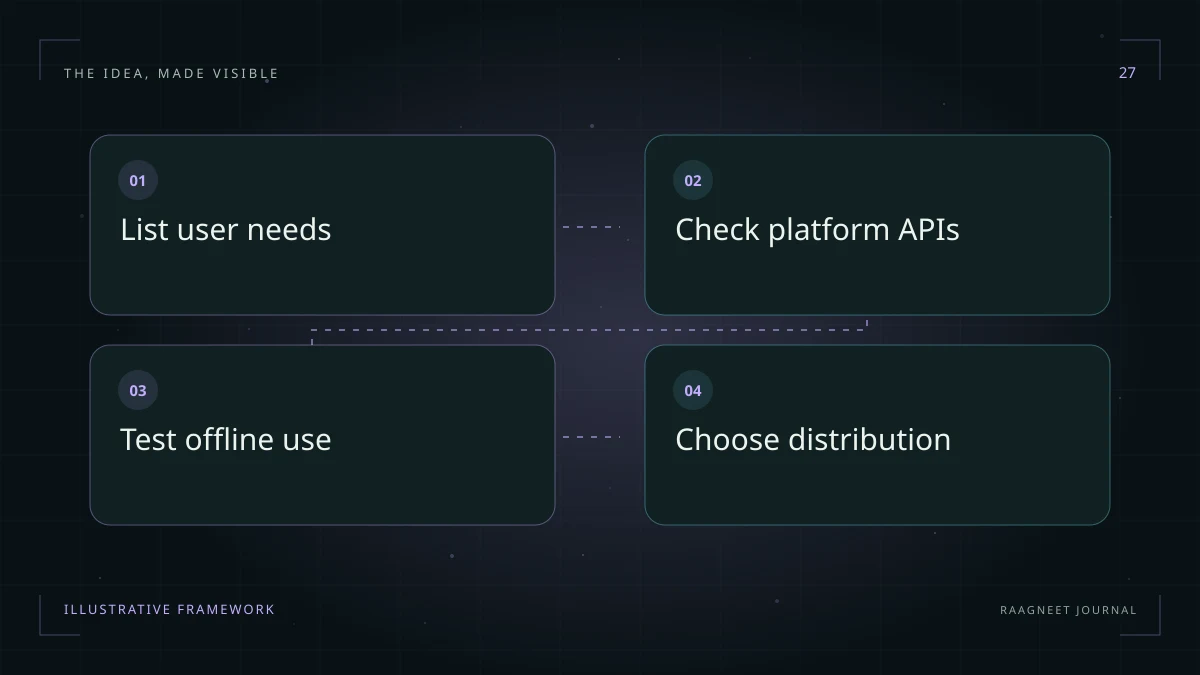
List the exact capabilities the product needs: camera access, background processing, notifications, payments, Bluetooth, file handling, or deep platform integration. Verify support for each target operating system and browser. A feature existing somewhere on the web does not mean it works consistently for your audience.
Native development can provide direct platform APIs and familiar distribution channels, but it brings its own review processes and implementation work. A cross-platform native framework changes some tradeoffs without removing the need to test platform-specific behaviour.
04Include distribution and updates
A web app can be shared through a URL and updated through web deployment. A native app may benefit from store discovery, managed enterprise distribution, or a familiar installation flow. Both need a plan for version compatibility and users who return with old cached resources.
Review service-worker update behaviour carefully. A cached old interface talking to a changed API can cause confusing failures. Keep update prompts understandable and avoid refreshing away unsaved work. Test the transition between versions, not only a clean first installation.
05Choose a product you can maintain
Compare the complete cost of implementation, accessibility, testing, analytics, support, security updates, and release management. A smaller initial build is not necessarily cheaper if key requirements later force a parallel native application.
Prototype the hardest required capability early and test it on real devices. A PWA may be a strong fit for accessible, linkable business workflows. A native app may be justified by platform-dependent functionality or usage patterns. Keep the decision tied to specific requirements and revisit it when those requirements materially change.
Common questions
Can a PWA work offline?
Yes, when the application deliberately caches the necessary resources and handles data state. Offline editing and synchronization require additional design beyond installing a service worker.
Are PWAs always cheaper than native apps?
No. Cost depends on required features, supported platforms, testing, and long-term maintenance. Prototype the most demanding capability before committing to an architecture.
Sources & further reading
Primary documentation and further reading are linked below. Examples and decision frameworks are illustrative; product capabilities can change.
Created with AI assistance for the RaagNeet Journal. This guide does not claim original product testing or benchmark results. Original illustrations by RaagNeet. Send a correction.