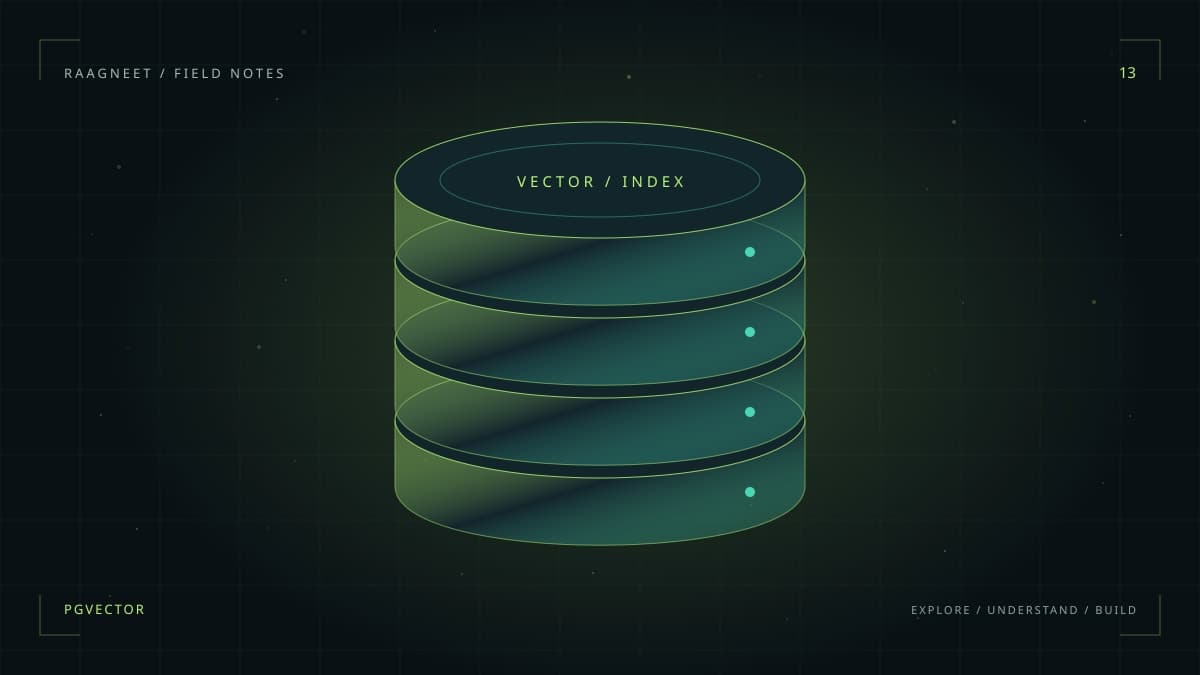
A vector database stores representations that help applications find semantically similar items. If your business data already lives in PostgreSQL, pgvector lets you add this capability without immediately introducing a separate database. The decision should come from retrieval requirements and operational constraints, rather than a belief that every AI feature needs a new data platform.
01What pgvector adds to PostgreSQL
pgvector is an extension for vector similarity search in PostgreSQL. It supports exact nearest-neighbour search and approximate indexing approaches including HNSW and IVFFlat. Exact search and approximate search offer different tradeoffs between speed, memory, build time, and recall. [1]
A documentation search feature can keep document identifiers, permission metadata, and embeddings near the rest of the application data. This is convenient, but convenience alone does not establish that one configuration will meet your latency target as the dataset or concurrency grows.
02Include keyword search in the comparison
A vector-only design can miss exact identifiers or unusual product codes. PostgreSQL can combine full-text retrieval with semantic retrieval, allowing a hybrid design within one database. This is useful when search requests include both natural language and precise terminology. [2]
For an illustrative support library, compare queries such as how to reset an account and ERR_SESSION_42. The first asks about meaning; the second requires exact matching. The database evaluation should represent both patterns instead of optimising only a demonstration query that favours embeddings.
03Benchmark the right workload
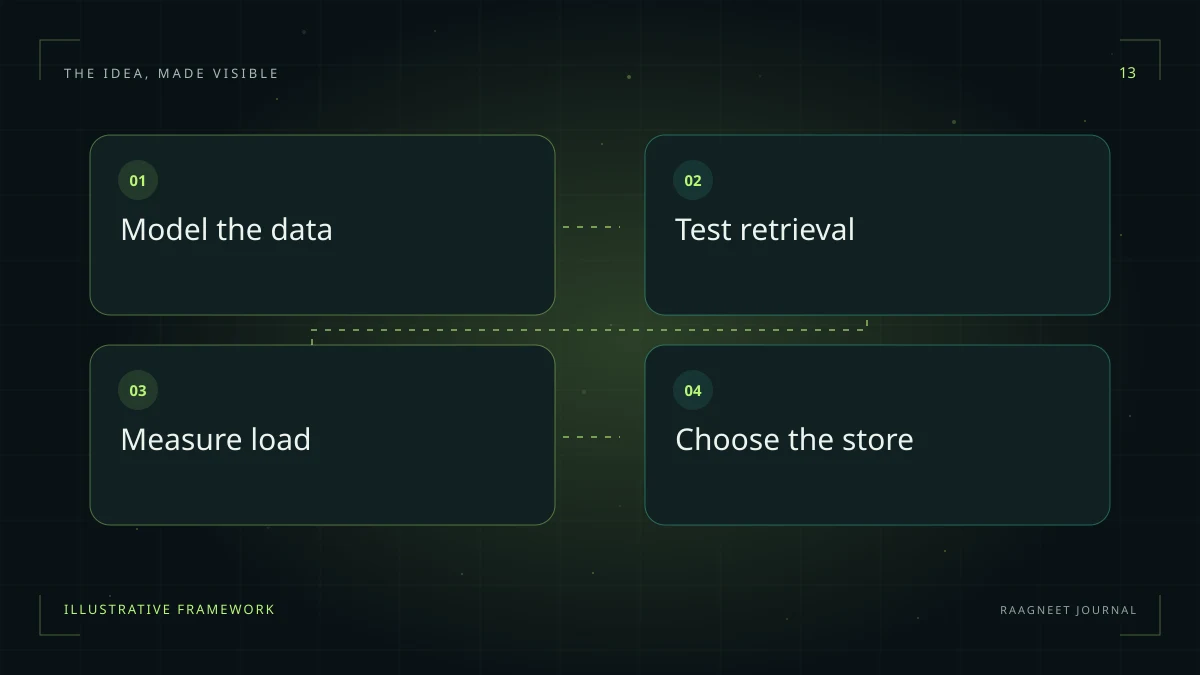
Build a sample with realistic document sizes, embedding dimensions, metadata, update rates, and access filters. Measure recall and latency together. A fast approximate result is not useful if it omits the document needed to answer the customer's question.
Test concurrent reads alongside document updates, not just one query against a static local dataset. Check query plans and index memory use. Filtering can interact with approximate search, so verify how your chosen version behaves when only a small portion of the data is permitted.
04Compare operational responsibilities
A dedicated vector service may offer specialised retrieval features and scaling controls. It can also introduce another bill, backup policy, permission model, and synchronization path. Write down who owns each of those responsibilities and what happens when data updates arrive out of order.
Keeping vectors in PostgreSQL may simplify transactions and joins, while also adding workload to a database that serves other important operations. Consider isolation, resource limits, and recovery. The best architecture protects the existing application as well as the new search feature.
05Choose a reversible first step
Separate document preparation and embedding generation from the storage interface. Store source identifiers and embedding-model versions so that you can rebuild an index or migrate later. Changing embedding models may require regenerating vectors, not simply renaming a column.
For a modest application already using PostgreSQL, pgvector is a reasonable option to evaluate first. A specialised system becomes compelling when measured requirements justify it. Keep the decision grounded in acceptable retrieval quality, sustainable operations, and a realistic growth path rather than a universal scale threshold from someone else's workload.
Common questions
Is pgvector always cheaper?
No. It may reduce infrastructure complexity when PostgreSQL is already present, but compute, memory, indexing, and operational effort still cost money. Compare the actual workload.
How many vectors can PostgreSQL handle?
There is no useful universal number. Dimensions, indexes, filtering, hardware, update rate, and latency targets all matter. Benchmark a representative workload and inspect query plans.
Sources & further reading
Primary documentation and further reading are linked below. Examples and decision frameworks are illustrative; product capabilities can change.
Created with AI assistance for the RaagNeet Journal. This guide does not claim original product testing or benchmark results. Original illustrations by RaagNeet. Send a correction.