AI can help build software, prepare marketing material and support operational tasks. Running a business also involves accountability, judgment under uncertainty and commitments to other people. A demonstration of an agent operating a simulated shop is useful evidence about that environment, but it does not establish that an unrestricted real business can safely run itself. This guide explains a more practical way to apply the technology.
01Understand what the demonstration tested
Google's Neon announcement includes a business-simulation evaluation, while Microsoft's model card discusses limits on autonomous work. These are scoped observations. They do not remove the need to test real suppliers, customer expectations and exception handling in your own operation. [1]
When assessing a demonstration, ask what information the agent received, which actions were allowed and how failure was scored. An environment with clean inputs and reversible actions may omit exactly the difficulties that dominate a small business's daily work.
02Separate production from responsibility
A model can draft a landing page or prepare an invoice summary without owning the promises those artifacts contain. Someone must decide whether pricing, fulfilment details and customer commitments are correct. Treat these decisions as part of the process, not inconvenient final checks.
Use draft states for externally meaningful outputs. A product description can be reviewed before publication, and a proposed customer response can be approved before sending. This captures much of the preparation benefit without pretending that text generation transfers business accountability.
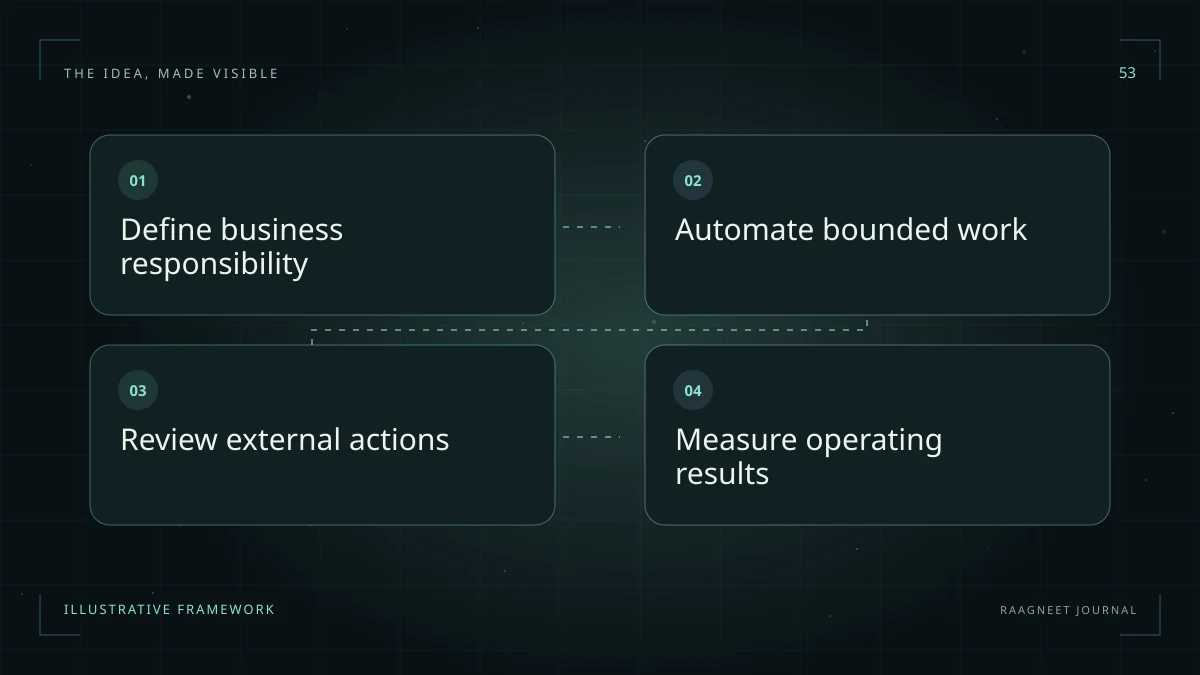
03Start with a bounded operational loop
Choose one recurring task such as summarising incoming enquiries or checking whether a project brief is complete. Define the input, required output and conditions that must reach a person. Keep the initial tool set narrow enough to explain clearly.
Measure accepted work and the time needed to inspect it. Include messy inputs and unsupported requests in the pilot. A system that performs well only when customers supply perfect information is not ready to manage an ordinary customer-facing operation.
04Control resources and external actions
Give the workflow a spending ceiling and explicit permission boundaries. Separate retrieving records from modifying them and drafting messages from sending them. Use application-level controls so the model cannot expand its own authority through an instruction found in external content.
Plan for unclear outcomes. If a tool call times out after a possible write, check the record before retrying. Keep action logs and an easy pause mechanism. These operational details determine whether automation reduces work or creates a harder-to-diagnose backlog.
05Build a supervised operating system
Assign an owner to each automated workflow and a reviewer to its exceptions. Maintain a short record of accepted outcomes, errors and corrective changes. Increase scope only when the system handles realistic variation and its remaining limitations are understood.
The achievable result may be a leaner team with less administrative preparation, not a business with no human involvement. That is a meaningful improvement when it is measured honestly. Choose automation by the work it completes rather than the appeal of a fully autonomous label.
Common questions
Can an AI agent launch a website for a business?
With suitable tools it may help create and deploy a website. The business still needs to verify content, ownership, integrations and promises made to customers. A live page is not the same as a complete operating business.
What should stay under human control?
Define boundaries around commitments, spending, access changes and unusual customer situations according to the operation's needs. Start with reviewed drafts and narrow permissions, then expand only when evidence supports a specific additional responsibility.
Sources & further reading
Primary documentation and further reading are linked below. Examples and decision frameworks are illustrative; product capabilities can change.
- Anthropic: building effective agents
- Google: introducing Gemini 4 Neon
- Microsoft: MAI Code 2 model card
Researched against primary sources on 23 November 2026. Recommendations are editorial analysis, not a hands-on benchmark. Pricing and access can change. Original illustrations by RaagNeet. Send a correction.